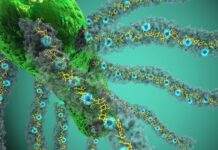
A team of engineers from the Massachusetts Institute of Technology (MIT) has managed to design living materials (biofilms or biofilms) that can incorporate non-living materials such as quantum dots or gold nanoparticles . All from bacterial cells. The work has been published in the journal Nature Materials .
These materials, which arose after inducing bacterial cells (specifically the E. Coli bacteria) to produce these biofilms, have the same characteristics as living cells , therefore, they produce complex biological molecules, they respond to their environment; but in addition, they have the characteristics of non-living materials , so they can also generate electricity or emit light.
“Our idea is to put the living and non-living world together to make hybrid materials that have living cells in them and are functional; it's an interesting way to think about materials synthesis, something very different from what is being done now, which is generally a top-down approach, "says Timothy Lu, assistant professor of Electrical Engineering and Biological Engineering at MIT and author. principal of the study.
The researchers, who demonstrated that the cells of the biofilm could coordinate with each other to control the composition of the biofilm , believe that these hybrid materials could have many potential applications in a wide variety of fields, such as: the conversion of agricultural residues to biofuels, diagnostic sensors, self-healing materials, or even solar cells.
Image credit: Yan Liang