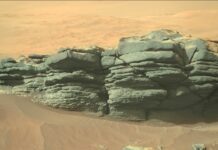
After the enigmatic announcement of John Grotzinger, principal investigator of the Curiosity mission, in which he spoke of promising results of the robot that explores Mars, the illusions were deflated in the press conference offered yesterday at the annual meeting of the American Geophysical Society. The Curiosity robot has not found life or traces of it on the neighboring planet , although its first soil analysis has detected very simple compounds that contain carbon. These are very small samples consisting of a carbon atom with one, two, or three chlorine atoms attached to it.
According to experts, these compounds could have been generated in the same SAM (Sample Analysis at Mars), the instrument used to analyze these types of molecules. The heat could have decomposed natural components of Martian soil to form these chlorinated molecules.
The origin of the carbon found is a mystery. It could be molecular remains of Martian organisms dead millions of years ago, but also inorganic compounds such as carbonates, or the remains of more complex molecules, such as aromatic hydrocarbons synthesized in stars and incorporated into comets and asteroids that rain down on all the stars. bodies of the Solar System. The answer to this question will require, as NASA technicians say, a lot of patience.