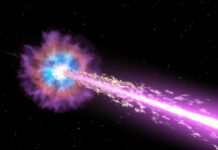
A peculiar gamma ray burst (GRB) that took place in space on Christmas Day 2010 could be caused by themerger of two stars, a neutron star and a giant star, after a stage in which they shared wrapping. In addition to a much higher than average life, GRB101225A – nicknamed“the Christmas blast”– showed an afterglow caused by thermal origin. An international group of astronomers, led by Christina Thöne and Antonio de Ugarte Postigo, from the Andalusian Institute of Astrophysics (IAA-CSIC), publishes in the journalNature a work that exposes how the merger of two stars could explain the phenomenon.
Until now there were two mechanisms to explain GRBs: long GRBs (two or more seconds long) are due to the collapse of a very massive star, while short ones (less than two seconds) are produced by the merger of two compact objects, such as neutron stars. Thanks to the Spanish study, three modalities are now distinguished.
The binary system in which the Christmas explosion occurred was located at5.5 billion light yearsand formed by a neutron star (a degenerate star that can contain the mass of the Sun in a radius of tens of kilometers) and an evolved giant star. According to the researchers, it went through a common envelope phase when the neutron star entered the atmosphere of the giant star, which during this stage lost most of its component hydrogen. Later, when the neutron star and the giant merged, the explosion produced a jet similar to those generated in normal GRBs, but which was heated by interaction with the pre-existing common envelope.
About ten days after the gamma-ray burst began toemerge a faint supernova explosionthat reached its maximum after forty days. Long GRBs are often accompanied by a bright supernova, the brightness of which appears to be related to nickel production during the event. “Our scenario predicts the production of a small amount of nickel that would lead to a very weak supernova explosion, which makes it more consistent with the observations” points out Christina Thöne (IAA-CSIC).
After years of researching GRBs, astronomers have observed that these objects hold many surprises and that“the stars seem to have very different ways of dying”, concludes Thöne.