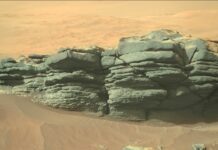
In the past week,the riverbed of the Tinto river, in the province of Huelva, in southern Spain, hosted a test campaign in which an ESA rover, a prototype spacesuit and a medical monitoring system similar to those that will one day be used in exploration were tested manned from Mars. The landscape and terrain conditions that surround Rio Tinto make it aideal setting to simulate a mission to the Red Planet.
Despite the typically dry and sunny climate in the region being overshadowed by heavy downpours and strong winds, teams from ESA, the Austrian Space Forum and local organizers were able to achieve most of the goals they had set. for the campaign. They return home with a lot of lessons learned and a lot of data that the scientists, doctors and engineers involved in the project will now have to study.
This was the first time that theEurobot Ground Prototype, a rover equipped with four wheels, he ventured into the real world to put all his abilities to the test. This new robotic assistant is designed to move and work on another planet, both independently and supporting the work of astronauts. Eurobot has its own eyes, a set of sensors, and a pair of arms on which interchangeable tools can be installed. It iscapable of carrying an astronaut, which can be operated by voice command or by using a small joystick.
The Rio Tinto campaign also served to test anew prototype spacesuit, the Aouda.X, developed by the Austrian Space Forum (ÖWF). Aouda.X hasa screen integrated in the visor, an air circulation system and carbon dioxide removal, a medical monitoring team and a communication system. Their gloves and gaskets are designed to simulate the rigidity they would have in an alien atmosphere, making the experience almost real.
The inner vest is the latest version of theESA’s Long-Term Medical Monitoring System(LTMS, in its English acronym), a device capable of measuring the vital signs and various physiological parameters of the astronaut at all times.