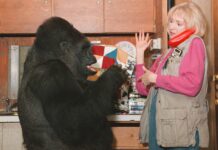
She is small and has a nervous and determined demeanor. He does not seem very friendly to the conventions: this must be one of the reasons why in 1993 he was awarded the Chair of Language and Communication at the prestigious University of Oxford. He previously taught for 25 years at the London School of Economics and did research work in countries such as India and New Guinea.
In college he learned Greek, Latin, some Hittite and Sanskrit, to which he has added French and modern Greek. But Jean Aitchison considers herself more gifted at analyzing languages than at learning them and acknowledges that “until very recently only a handful of crazy and eccentrics have worked on the origin of language.”
His work consists of putting the pieces of a gigantic prehistoric puzzle in which disciplines as diverse as archeology, anatomy, physiology, ethology -study of the behavior of animals-, the theory of evolution, psychology and anthropology.
–Is language written in our genes?
-Yes. Language is an innate human-oriented behavior. If we hear the song of birds, we only distinguish noise, we have no idea how to learn or interpret it. However, newborns instinctively know what to look for in language.
–What would happen if as children we had not been in contact with any language?
-There are cases of children who have not learned human language well until they have come into contact with civilization. The most famous was that of Genie, a 14-year-old girl who found herself in California without knowing any language. He had a lot of trouble learning to speak and was never able to do it properly. Some said his brain was damaged due to poor nutrition, and others that he was too old to do so. Surely it was due to both.
–What other animal does human language resemble?
-It is more similar to that of birds than that of chimpanzees, due to our ability to produce fast and precise sounds. According to some researchers, the upright position may have been the trigger for a series of anatomical changes; Among them, that our larynx is located lower in the throat, which allows us to close the nasal cavity and produce vowels through the mouth. Chimpanzees make vowel-like sounds, but they are not clearly distinguished because they are nasal. Humans and birds also agree that they have a learning time for their sounds. During this period, young birds babble like babies. Many birds have dialects, which differ from one area to another. For example, by the song of the California white crowned lark you can tell where you are in California.
–What are the main differences between our language and that of primates?
-Physically, modern humans have two advantages over chimpanzees: a muscular tongue that we control and the ability to produce vowels through the mouth and not through the nose. But the most important thing is a control system to coordinate everything. The pronunciation of a single syllable word requires coordination in time and space of a minimum of 70 muscles and 8 to 10 different parts of the body, from the diaphragm to the lips. This coordination is perhaps possible thanks to the long childhood of humans. Mentally, what differentiates us is that people need to know the name of things. You can teach a chimpanzee the name of an object, but it only learns because it thinks we are going to reward it. You can’t make him appreciate the importance of naming things, he doesn’t have that instinct. This, which may have been the barrier that has prevented them from acquiring a language, is more important than the lack of sophisticated vocal organs.
–How were the names of things invented?
-It’s a mystery. Probably, humans arrived at the first words in different ways: the sounds of nature, the imitation of animals, screams of excitement or grunts of effort … Even today it is very rare that names are invented from nothing. Humans probably already used a wide range of vocalizations from various sources before developing the instinct to name.
–Did man exist before language or was it language that created man?
-The relationship between brain size and language is not yet clear, but it seems likely that they were mutually reinforcing. The human brain has similarities to that of other primates, but has some differences. It is three times larger than that of the chimpanzee, twice that of Homo habilis, and a third larger than that of Homo erectus. Zoologists say that only modern humans have had language, but I believe that previously there were different groups of humans with an embryo of very simple language, made up of a few words. Probably a small isolated group developed a more sophisticated language, imposed it on others, and began to expand.
–What was that first language like?
-My point of view is that at first it was very confusing, messy, like one of those roundabouts with so many directions in which everyone gets lost. You would speak something like “I want food”. Only gradually did a structure take hold.
–You have highlighted the ability to deceive as a fundamental element in language development …
-Humans can talk about remote things in space and time, things that happened yesterday or elsewhere. This feature of language, called displacement, is believed to have developed with the ability to tell lies. If we couldn’t lie, we couldn’t talk about things that are absent.
–However, in our society lying is frowned upon …
-In spite of what we have been taught, it is not necessarily a bad thing, because to deceive successfully you have to be able to understand another person’s point of view. Imagine the importance of this ability compared to the communication systems of animals, limited to fixed messages about everyday events such as food, danger, coupling or territorial rights. In fact, the closer primates are to humans, the better they are at deceiving. It seems as if, outside of the trees, they needed a greater social organization. Our closest relatives, chimpanzees, are very adept at deceiving from a young age. A baby chimpanzee may scream as if attacked only to be fed and pampered by its mother. Baboons and gorillas do quite well too, but monkeys not so well. The cunning may have helped the development of the brain and, in parallel, that of language. Of course, primates only cheat to satisfy their selfish needs, when they want things, and humans use this property in a much broader sense.
–Are people who speak very primitive languages able to understand modern civilization?
-There are no longer primitive languages, but simplified ones, but even someone who only spoke one of them is mentally as sophisticated as any other. The belief that one who speaks simple languages is not mentally developed is a prejudice of the last century.
–Why is it easy for some to learn foreign languages and for others difficult?
– There are those who say that those people who have had to learn another language besides their mother tongue have a facility to learn languages. According to another theory, related to this one, language learning is a skill you are born with, but you have to practice it to keep it. After 13 years of age, this ability is lost and, if no other language has been learned, except one’s own, it is very difficult to reactivate the process. Although the truth is that some individuals continue to learn languages perfectly until the end of their lives. Perhaps it is because they are interested or perhaps because there is something different on their minds.
–It has been said that women – have more ability than men to learn languages …
-Women perform better than men a wide range of verbal skills, and men outperform women in spatial tasks. This is apparently due to hormonal differences that affect the embryo. Another view, recently debated, is that man’s brain is more lateralized, with abilities more firmly localized in one hemisphere than another. According to a highly controversial evolutionary interpretation, early hunter-gatherer humans may have divided roles. The men would be responsible for hunting large animals, which requires traveling long distances and finding their way back, and the women would search for food near the home, take care of the children, and talk with them and with each other.
–How is the language evolving?
-Many languages are being lost very quickly. The younger generations want to speak the languages that allow them to be honorable and rich, such as European languages or Japanese. And they are beginning to underestimate their vernacular languages. If this trend continues, half of the 6,000 languages estimated to exist today will have perished by the end of the next century. These are the dying languages, which are no longer learned as the first language by the new generation of speakers. Another 2,400 will be close to extinction, because no language spoken by fewer than 100,000 people is safe. That will leave 600, 10 percent of the current total.
–So how do you see the future?
-Few languages will survive, which will spread throughout the world, and then it is likely that they will be divided into different languages, in the same way that Latin was divided into French, Spanish, Italian, etc. Right now, some varieties of English are considerably different from others. But the structural diversity that exists today will inevitably shrink. And with it, great wealth will have been lost.
Teresa Ricart
This interview was published in August 1996, in number 183 of VERY Interesting