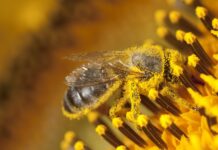
Researchers at the Freie Universität Berlin have developed a robot whose operation is inspired by the nervous system of the bee -which is relatively simple-, to perceive environmental stimuli and learn to react to them.
The most outstanding feature of this mini artificial brain is its ability to learn through very basic principles . Thus, the robot is capable of linking certain external stimuli with behavioral rules, that is, just as, for example, bees learn to associate the colors of flowers with nectar that is more or less tasty or succulent, the robot also learns to approach certain objects colored and avoid others.
For the development of the experiment, they placed a series of red and blue objects in a closed circuit, where each time the robot looked at the red objects, a flash of light was produced, thereby making the robot detect the flash as a reward for focusing on an object of that color .
The processing of the color red together with the reward in the robot's brain, caused a series of specific changes in its behavior . Thus, each time the robot saw a red object, it immediately moved towards it. If he saw blue objects, he backed away. Learning in seconds.
Scientists plan to expand the robot's neural network by complementing more learning principles, in order to make the robotic mini-brain increasingly powerful and thus more autonomous.