General Electric is one of the giants of nanotechnology, the science of the ultra-tiny that promises to revolutionize industry, medicine, security and alternative energy.
“First I find out what people need. Then I proceed to invent it,” he wrote.Thomas Alva Edisonafter inventing the incandescent light bulb. At the headquarters of the Advanced Technology Program ofGeneral Electric(GE), in the New York city of Niskayuna, have followed the same philosophy since 1890, when Edison founded what is now the third largest company in the world. Its highest endorsement: 66,578 registered patents. Thousands of brilliant scientists walk through the white corridors of his modern building who, together with their colleagues in Munich (Germany), Bangalore (India) and Shanghai (China), make Edison’s phrase come true.
GE is committed to developingnano-sized technologies. Recall that a nanometer (nm) is one millionth of a millimeter. At this very small scale, matter gives real surprises. The more than 150 experts who work in the Nanotechnology Laboratory bring to light the unknown feats of materials that we thought we knew in depth and that they give tothe dwarfgigantic potential. “We discover new properties that not only force us to rethink some laws of physics, but also open our eyes to previously unknown capabilities of ceramics and metals,” says Margaret Blohm, director and founder of General Electric’s nanotechnology program.
A small world that is governed by its own laws
“Knowing that a key part of your knowledge about a material is incomplete is a golden opportunity that occurs once every century,” says the scientist while preparing a solution of water with ferrous oxide chips to conduct an experiment. “When the iron shavings are big, if I put a magnet on them, they all crowd around it. Well, now we will see what happens if I put 50 nanometer particles in the water, much smaller than the shavings.” Blohm passes the magnet over this new solution and something extraordinary happens: the black water rises and forms a bristling ball with spikes whose size changes with a slight movement of the magnet. “What is this? A solid? A liquid? No. It’s something we’ve never seen before! And we’ve only changed the size of the particles. It’s a new form of matter.”
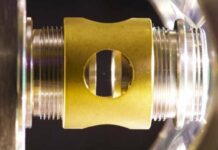
ThisnanosolutionIt is already used in industry – for example, to seal two surfaces that rotate with each other – because it has all the advantages of solids and liquids, and none of their drawbacks. But Blohm’s team wants to go further and reduce the size of the iron balls. If it does, it will revolutionize diagnostic medicine. “We are looking for 5 to 20 nm particles to use as contrast agents in our MRI scanners,” explains Blohm. The problem with current images is that, although they show the structures of the tissues, they often do not allow us to determine whether they are tumorous. Hence, a biopsy has to be done? “The advantage thatnanocontributes to the image is its great contrast, because the iron particles send a very strong magnetic signal “, clarifies Blohm. And not only that:” The smaller they are, the more their magnetic properties increase. In addition, they are degraded in the body. The particles being administered now measure about 100 nanometers – they are large – and are rapidly absorbed by the liver; therefore they can only be used to obtain images of this viscera. To overcome this limitation, we are selecting iron oxide nanoparticles that we coat with biocompatible materials with various organs. So we can see images at the molecular level. “
Another crucial goal of GE experts ispeek outto the nature. This and whatnano they are synonymous, according to Blohm. “We have a lot to learn about himdesign in the natural world, like the legs of the gecko, which work like velcro; the wings of the butterfly, whose colors change according to their interaction with the light; and thehydrophobicity of lotus leaves, which keep their surface clean. “Their extreme watery rejection is due to the fact that they are covered by nanometric hairs.
When water falls on this tapestry, perfectly round drops are formed. Each of them behaves like a dancer on the tips of her shoes, which touch a small part of the ground. As a consequence, the drops roll on the plant surface and “carry away the dirt that dirties the leaf. Let’s not forget that the lotus lives in muddy terrain. That is, the leaf scrubs itself”, explains Blohm. And he adds: “We want to replicate this property in substances that, applied on a surface, allow theautolimpiezathis. I have never seen my people so excited about a product, and its applications could be limitless. The interaction between a fluid and a surface creates many problems: dirt covers gas turbines, ice sticks to airplanes, dirt stains windshields … If we could keep these objects pristine, their performance would increase dramatically. “
 The tunnel of wind and ice that occupies the center of Blohm’s laboratory resembles a gigantic coiled black snake. Its function is to shoot water droplets of different sizes and speeds against metal sheets. “A 15-micron drop of water -like those that surround an airplane in flight- adheres to a material according to its porosity and shape. We study with what force ice sticks and we design new metallic textures that avoid it. We have achieved this. a 70% reduction in adherence “. The lotus leaf is not your only source of inspiration. A pink snail adorns a table in honor of another of the laboratory’s objects of study: they are ceramics, light and resistant to high temperatures, but very brittle. “Look at this snail – says Blohm -. It is the same material as chalk – calcium carbonate – but three orders of magnitude more resistant, due to its structure. It has nanolayers arranged in sheets that are interspersed in various directions. When in the shell A crack is formed, it does not go any further because its energy is absorbed by millions of sheets. That does not happen with ceramics or chalk, where such architecture does not exist. “
To create a material similar to that devised by the snail, you have to put the correct substance in the appropriate place and time, and have it follow a process ofcar assemblythat allows you to have an exquisite control of your microarchitecture. Blohm explains how they have achieved this in his laboratory:? The first step is to build the structure with a precursor material for ceramics. We already did it with polymers. The material is self-assembling,You knowwhat to do when it is subjected to high temperatures and the polymer becomesceramics?.
Upstairs, above the ice tunnel, is the chemistry and biological sensors lab. There Amy Linsebigler investigates the wings of thebutterflies of the genusMorph o, which have nanostructures capable of distinguishing volatile organic compounds. “This natural design has applications in security and industry,” says Linsebigler while holding up an iridescent blue copy of aMorphotropical. “We want to develop materials that copy those nanostructures to create supersensitive chemical sensors.” The light interacts with the wings of the insect according to the angle of incidence and, when exposing the wing to different gases, its color varies subtly. “We can thus identify what vapor is in the air just by seeing the changes in the butterfly. We are thinking of designing a device that sniffs the air in real time, something like small units that are worn on the flap and warn of the presence of a toxic gas “.
Along these lines, the nanochemistry laboratory has created aportable sensor that detects harmful agents-chemical and biological-just by firing a small laser beam, no need to get your hands dirty or remove your Hazmat protective suits. People responding to a pollution emergency have to use several very bulky gadgets. According to Linsebigler,? Classic Raman units that detect chemicals cannot sense a virus or bacteria. We create nanoparticles that stick to biological species according to their size and respond to light of a certain wavelength. For example, if you are looking for bacteria sporesBacillus anthracis-which causes anthrax and is the object of desire of bioterrorists- do you coat the sensor with the nanoparticle the size that works with this microbe?
We have passed through the ages of stone and iron, we are immersed in the age of silicon and now, the erananoit has already dawned. Loucas Tsakalakos, leader of the photovoltaic energy team, with a 9,000 m2 laboratory on the GE campus has no doubt about this. “We have shown that it is possibledevelop a photovoltaic solar cell made of nanowires with very high efficiency at very low costs“says Tsakalakos as he places a small blue square in my hand.” We create the nanowires based on silicon, which is abundant and cheap, and we deposit them in extremely thin layers on a glass, metal or plastic substrate. “
The key is to make the structure using nanotechnology in a totally different way from how current solar cells are made. Nanowires are grown from silicon crystals in the form of brocades, rather than solid pieces. The structure creates light traps and exponentially increases the ability to capture the sun’s rays. Hence, its performance is much higher than that of solid pieces, which are highly reflective. “We have yet to demonstrate the potential of this development. Our calculations tell us that it will be extraordinary, but for now we have only taken baby steps,” says Tsakalakos. GE’s dream is to turn these little steps into strides. For Margaret Blohm, the route is laid out.
“The industrial challenge is to translate these scientific innovations into cheap, productive technologies.nanoit will be infinitely better for the environment once we understand how to control it. Yes, there are health risks, as the tiniest particles go to the kidneys. But we will study safety, as with any other new product. “
That liquids are liquids and solids are solid is no longer something that we can repeat with the same conviction as before. ThenanomundoIt’s humbling us all: size doesn’t just matter, it changes everything.
Angela Posada-Swafford