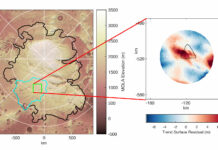
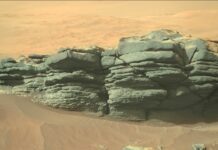
Clays discovered in 2005 by the Mars Reconnaissance Orbiter probe in the southern hemisphere of Mars had been considered, until now, as proof that 4,000 million years ago the red planet harbored liquid water and had conditions suitable for life . But a study published in the journal Nature Geoscience reveals that these clays could have a volcanic origin and that the Martian environment of that time was by no means the most suitable for life.
The team of researchers, led by the Institute for Environmental and Materials Chemistry (Poitiers, France), came to this conclusion after finding many similarities between Martian clays and others found in the Mururuoa Atoll (French Polynesia), which contain iron and magnesium clays trapped between crystallized material. These materials were formed due to thevolcanic action, without any alteration mediated by water flows taking place.
This discovery does not invalidate other theories about the presence of liquid water and the habitability of the red planet. There are manyhints of rivers and lakesthat existed on Mars about 3,000 million years ago, and the sedimentary formations of the Gale crater, which will be explored by the Curiosity robot in the coming months, are also evidence of the presence of water in a recent period. However, it seems that these conditions of habitability are not as old as previously believed, and, at least for now, there is no evidence to say that 4 billion years ago the surface of Mars was fit for life.