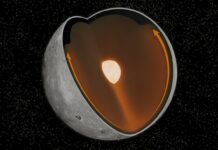
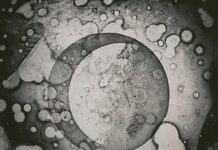
Thelunar crust was almost totally pulverizedin the past byasteroid and comet bombardments. This is the conclusion reached by the geophysicist Maria Zuber, scientific head of GRAIL (acronym forGravity Recovery And Interior Laboratory), after analyzing the map of the lunar gravitational field generated by the two probes that make up this NASA mission, which has been described as the “highest resolution obtained to date from a celestial body”. In fact, the map shows the structure of the different strata of the satellite, including its core, as well as the distribution of masses, which makes it possible to analyze tectonic structures, craters …
According to the investigation,the lunar crust is much thinner than scientists thought, given that it has a thickness of 34 to 43 kilometers, that is, between 6 and 12 kilometers less than what had been estimated until now. Furthermore, the pictures show that98% of the Moon’s crust is fragmented by multiple impacts. “It was known that the rocky planets of the solar system had suffered many impacts several billion years ago, but no one thought that the lunar surface had been so massively bombarded,” admitted Zuber, who published his findings in the journal Science. In fact, the fractures reach the deep crust and even the mantle.
The outer crust of the Moon lacks dense rocky structures and is probably made up of porous or pulverized materials. The map of the interior of our satellite also reveals the existence ofdenser masses formed by volcanic magma, which ended up solidifying and forming dense rocky walls.