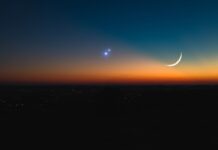
The full Moon on the night of May 5 to 6 will be perceived 14% larger and 30% brighter than usual when the natural satellite approaches Earth at the shortest distance so far in 2012, according to reports. NASA statement. The perigee (the minimum distance between the two celestial bodies) will be 356,953 km at 03.34 GMT on May 6, about 16,000 km below the average. The perception of the increase in size will be more pronounced as the satellite hovers over the horizon. When near perigee, the Moon appears about 14% larger and 30% brighter than when it is at its apogee, on the other side of its orbit.
The convergence between the full moon phase and the perigee will allow us to contemplate the phenomenon nicknamed "super moon" . A similar phenomenon was observed on March 19, 2011, when the Moon approached our planet at a distance of 356,577 km.
On the other hand, as explained by NASA, a perigee full Moon brings with it "perigee tides" , higher than normal, although this should not be a cause for concern. In most places, the gravity caused by the Moon in its perigee causes the tidal water to rise a few centimeters, at most fifteen in some places.