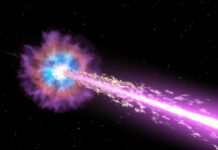
This is the first time in history that a team of astronomers has managed to observe the violent death of a massive Wolf-Rayet (WR) -like star. Specifically, this star is 360 million light years away in the constellation of Bootes and died due to an explosion known as supernova II b. The finding has been published in the journal Nature .
WR-type stars , characterized by being very massive and hot (they are 20 times more massive than our Sun and five times hotter), suffer enormous mass losses caused by intense solar winds . Outside of this data, because they are quite rare and are usually obscured, the experts do not have a great knowledge about their formation and their death.
However, thanks to the ‘intermediate Palomar Transient Factory’ (iPTF), which uses the resources of the National Computational Scientific Center for Energy Research (NERSC) and the Energy Sciences Network (ESnet), both located in the US, whose purpose is to study events fleeting cosmic cells such as supernovae, a team of Israeli astronomers managed to capture the SN2013cu supernova within hours of its explosion . After directing the ground and space telescopes to their location, they were able to observe the event up to 15 hours after the star’s self-destruction .
“Developing new observational capabilities now allows us to study stars that explode in ways we could only dream of before. We are moving towards real-time studies of supernovae, ”says Gal-Yam, study leader.
“When a Wolf-Rayet star goes supernova, the explosion passes the stellar wind and all information about the parent star is gone. We were lucky with SN 2013cu, since we caught the supernova before it disappeared with the wind . Shortly after the star exploded, it released an ultraviolet flash from the shock wave that heated and illuminated the wind. The conditions we observed at that time were very similar to what existed before the supernova, ”says Peter Nugent, an astrophysicist at the Berkeley Lab Center and a co-author of the study.