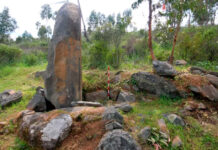
About 170,000 years ago there was a place where human beings lived quietly, with abundant resources and all their needs covered. This kind of prehistoric Eden has been baptized as the Palaeo-Agulhas Plain (PAP) and was located on a coastal platform in South Africa that today is submerged under water. The Quaternary Science Reviews magazine dedicates a special issue to it this month, and one of the articles reveals some of the keys that made this place a paradise on Earth.
The authors of the work have dedicated part of their research to observing the migratory patterns of antelopes at Pinnacle Point, a cave area on the modern coast of South Africa where archaeological remains of human settlements dating back 170,000 years have also been found.
“During glacial cycles, the coastal shelf would have been exposed,” explains Jamie Hodgkins, professor of Anthropology at the University of Denver Colorado and co-author of the work. “In this way, there would have been a good expanse of land in front of the caves, and we think it was likely that humans and other carnivores would have taken advantage of the herbivore migration to obtain abundant game.”
Animals that did not migrate
To study migratory patterns in the past, Hodgkings’ team studied the carbon and oxygen isotopes in tooth enamel of several large herbivores of the time, using a current type of antelope, belonging to the genus Redunca , as a control group. The basis of this analysis is that, in general, in the more humid and colder environments there is a greater abundance of C3 plants and in the driest there are more C4 plants (they are thus classified according to the metabolic route through which they make photosynthesis, leaving a different carbon isotope ratio). If the animals were migrating based on rainfall patterns, going east during summer rains (C4 pastures) and west following winter rains (C3 pastures), their tooth enamel would be registering these movements and feeding changes. .
But the results revealed that many of the species studied for this period and that are currently typically migratory, such as wildebeest, showed an absence of clear movement patterns. Most of the animals seemed happy where they were, without having to move from one place to another. “They weren’t competing for resources,” Hodgkins explains. “ We now know that this coastal area was supplied by powerful river systems, and the animals were not forced to migrate . During the interglacial periods, when the coastline approached the caves, humans could obtain shellfish and other resources from the sea, and during the ice age, when the coastline expanded, hunters had access to a wide variety of land prey. With all those herbivores roaming around, the hunters didn’t have to move that much. “
A refuge in the midst of catastrophe
74,000 years ago, one of the largest known volcanic eruptions took place, that of Mount Toba in Sumatra. It is thought that this event produced a global winter and that many human populations would have struggled to survive. In 2018, a team of researchers discovered that the humans of Pinnacle Point not only managed to survive, but also thrived in this kind of ecogeological refuge. Another proof that supports that, indeed, this earthly paradise existed.