Tech UPTechnologyThey use nanopyramids to trap living cells

They use nanopyramids to trap living cells

celula-piramide

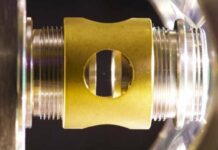
Researchers at the University of Twente (Holland) have developed a curious technology that allows living cells to be trapped inside tiny microscopic pyramids in order to study them in the laboratory. As the image shows, these tiny pyramids, created with three-dimensional manufacturing techniques at the nanoscale – that is, to a size equivalent to one ten thousandth of a human hair – have open walls to allow cells to interact with each other, as explained by the researchers in the specialized journal Small .

The nanoscientists tested the method with chondrocytes, which are the cells that make up cartilage. In the future they hope to take advantage of the gap between contiguous pyramids to create nanofluid channels to keep cells nourished during experiments. Furthermore, they are convinced that the method will help biologists and experts in regenerative medicine to better understand how tissue regeneration works .
Scientists discover bacteria that can use light to 'breathe' electricity

Breathe electricity? Scientists have shown that light speeds up conductivity in nature's 'electrical grid'.

Nanobots could benefit patients with catastrophic diseases

Armies of intelligent nanobots will be able to benefit thousands of patients with catastrophic illnesses that are incurable today, point out Fernando Castilleja and Juana Ramírez.

They manage to stop time with a sphere

A team of physicists has made this breakthrough at the nano-scale that could help us better understand quantum mechanics.

Scientists design nanoparticles to trap and kill coronavirus

In recent months we have witnessed how medicine has turned in the fight against the coronavirus. And recently, a group of scientists have designed nanoparticles capable of trapping and eliminating SARS-CoV-2.

They create a heart printed in 3D with human tissue

The work represents a milestone in regenerative medicine, although there are still many obstacles to overcome. In this case, the heart cells can beat but not pump.

More