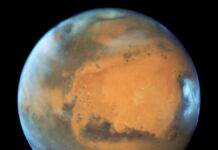
Is Life On Mars Possible? Researchers have now approached the answer to this question with a new study.
Kassel – It is one of the most important questions in space research: Can humans colonize Mars? A new study is now taking scientists further in answering the question. Because: Apparently, terrestrial soil bacteria can improve the growth of plants in the Martian soil. Just recently, NASA made an amazing discovery of Mars.
They would supply them with vital nitrogen, which is not available in the Mars regolith, report US researchers in the specialist magazine “Plos One”. The bacteria could make the soil of Mars more fertile at low cost and enable the production of food. The loose material is called regolith. It is formed by the weathering of the parent rock of rocky planets.
Life on Mars: US researchers gain new knowledge
The researchers led by Franklin Harris from Colorado State University (USA) write that it is unlikely that humans could remain a “one-planet species”. The scientists cite climate change and epidemics as reasons.
It is therefore necessary to develop methods for alien agriculture on other celestial bodies – such as Mars. However, the conditions there presented arable farming with many challenges. The surface material of Mars lacked many of the nutrients that make plant growth possible on earth – such as nitrogen. In addition, the atmosphere is thinner, the radiation is higher and the temperatures are more extreme.
The new study revolved around the lack of nitrogen. The scientists planted yellow sweet clover in conventional soil as well as in man-made regolith. Then they added nitrogen-fixed bacteria to half of the cultures. These nodule bacteria can be found on the roots of numerous plant species on earth – for example in peas, beans and clover. The bacteria can bind nitrogen from the atmosphere and then make it available to the plants in a soluble form. In return, they receive certain substances from the plants that they need for life.
Growing food on Mars: Bacteria improve plant growth
The result of the study: The addition of bacteria improved plant growth, especially in the earth’s soil – but also in the regolith. The plant shoots in the soil with bacteria were 2.5 times longer than in the one without. The biomass of shoots and roots more than doubled. In the regolith, too, the plants entered into a community with the bacteria. They formed corresponding nodules at their roots. However, the number of nodules in the regolith was considerably lower than in the terrestrial soil: an average of 14.5 compared to 63.
What the researchers did not find: An enrichment of the regolith with nitrogen, which other plants in the area could use. Presumably the growing plants had used up all the nitrogen themselves. In addition, the plants did not rot in the short period of the experiments.
Mars Study: Researchers Need More Research
The nitrogen remained in the roots and did not get into the environment. “This work will improve our understanding of the interaction between plants and microbes and will help make the regolith on Mars more similar to terrestrial soil,” the scientists write. However, numerous studies are still necessary for the development of practicable “astrolagriculture techniques”.
According to analyzes by the Mars rovers, apart from nitrogen, other micronutrients such as copper, boron and molybdenum are missing in the regolith. Furthermore, it is still unclear how the thin Martian atmosphere influences plant growth. In addition, the atmosphere contains only a fraction of the nitrogen that is available in the terrestrial atmosphere for nitrogen-fixing bacteria. (Jan Wendt)