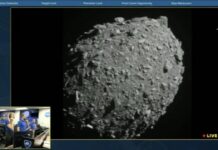
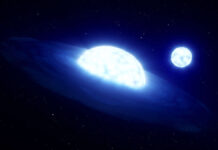
A well-known space object suddenly behaves differently than expected – and researchers are amazed.
Tuscon – Since the object was discovered in 2005 in the asteroid belt between Mars and Jupiter, it has been mistaken for an asteroid. Usually these are cosmic rocks that have no tail – unlike comets. They are described as “dirty snowballs” because they are made of dust and loose rock that is held together by ice. When a comet approaches the sun, ice evaporates – the gaseous tail characteristic of comets is formed.
Asteroid or Comet: The Mystery of the Cosmic Hermaphrodite
So asteroids and comets are completely different astronomical types. But now researchers have discovered that the old friend does not want to fit into either of the two categories – or, as a “cosmic hybrid”, into both. Because the heavenly body outgases and has formed a tail. This unexpected activity is due to a transformation of icy material, the scientists explain via (248370) 2005 QN173 – the asteroid name that reflects the date of discovery.
This turns the asteroid into a so-called “main belt comet”, explains Henry Hsieh from the Planetary Science Institute (PSI) * in Tucson (Arizona) in a study in the specialist journal Astrophysical Journal Letters. “It is one of only about 20 objects that are currently confirmed or suspected main-belt comets,” says the researcher. Some have only been spotted in an active stage. Celestial body (248370) 2005 QN137 however already several times.
Asteroid raced past Earth
The cosmic hermaphrodite (248370) 2005 QN137 is not the only asteroid that researchers keep a close eye on. On March 21, the asteroid 2001 FO32 * sped past Earth – at a safe distance of two million kilometers. Its speed was exceptionally high at just under 125,000 kilometers per hour. The reason: its elliptical orbit had only recently brought it quite close to the sun. The asteroid was thrown away and accelerated strongly. * Merkur.de is an offer from IPPEN.MEDIA