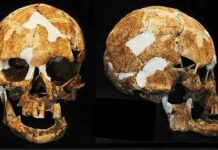
If you have been reading about human evolution and paleoanthropology for a few years now, you will be familiar with the species Homo heidelbergensis , a typical species of Europe in the Middle Pleistocene. For example, it may sound to you that the human fossils from the Sima de los Huesos in Atapuerca , among others, were assigned to this species. However, in recent years there is more and more talk of pre- Neanderthals to refer to these fossils of this age. What is this about?
New species are sometimes defined from fragmentary fossil material . Not all fossil finds are complete specimens, and sometimes even incomplete ones have enough new features to define species. The passage of time can change this. In the best of cases, new fossils will appear that will provide more data on this new species and will complete its diagnosis (set of unique characteristics that define it as a species). This is the case of the Deinocheirus dinosaur, which we have talked about recently. But it may be that over time the findings will show that the initial diagnosis was wrong. And then, you have to correct the mess. Well, something like that has happened with Homo heidelbergensis .
In recent years, advances in paleoanthropology have suggested that this species was problematic. It was initially defined in 1908 from only a mandible found in Mauer, which is the holotype of the species. Its resemblance to jaws found in the Cave of Arago , in the French Eastern Pyrenees, in which skull material also appeared, led to the adoption of this reconstruction for Homo heidelbergensis. So far so good: more material was found and the knowledge of the species was expanded. From there, many similar fossil finds followed one another in the European Pleistocene. But similar fossils were also found in Asia and Africa.
As a result, within a few decades we came to have an immense number of Middle Pleistocene human fossils assigned to Homo heidelbergensis . Some assigned to this species for resemblance to its holotype, Mauer’s jaw. Others, due to resemblance to Arago’s skull. Many others, due to resemblance to others previously assigned to the species. And we have reached a time when there are a large number of fossils of H. heidelbergensis , showing intraspecific variability . And this variability “leaves in diapers” the original jaw, the holotype of the species. In addition, nowadays, in Physical Anthropology, jaws are considered to be considerably more plastic and variable than skulls. And therefore, its characteristics must be treated with caution.
So, what is the thing? Can we still talk about Homo heidelbergensis ? For an amendment to this Middle Pleistocene Enigma has recently been proposed.
Firstly, it has been suggested that the species Homo heidelbergensis be abandoned , as it is poorly defined and has been widely variably understood and used. Also, because it does not reflect the variety of hominids from the Middle Pleistocene. It has also been suggested that the species Homo rhodesiensis suffers this same fate.
Second, the creation of a new species, Homo bodoensis , has been proposed, which would be a Middle Pleistocene ancestor of the lineage of modern humans or Homo sapiens. The distribution of this species would be pan-African, extending to the eastern Mediterranean and the Middle East. So what do we do with European fossils of this age that were assigned to H. heidelbergensis ? In this same review it has been proposed that all these fossils from Western Europe (for example, those from the Sima de los Huesos de Atapuerca) be reassigned to Homo neanderthalensis , thus reflecting the early appearance of traits derived from Neanderthals in the Middle Pleistocene European.
Now it is the turn of the rest of the paleoanthropological community. It is up to you to check if your data matches this proposal and follow it. We will see how this new panorama of the Middle Pleistocene looks as research and new findings progress. One thing is clear, far from everything being discovered, we are living an exciting moment in Human Paleontology .
References:
Rosas, A.; Bermúdez de Castro, JM 1998. The Mauer mandible and the evolutionary significance of Homo heidelbergensis. Geobios, 31(5): 687-697.
Martinón Torres, M. et al. 2012. Morphological description and comparison of the dental remains from Atapuerca-Sima de los Huesos site (Spain). Journal of Human Evolution, 62 (1): 7–58.
Arsuaga, JL; Martínez, I. 1997. The chosen species: the long march of human evolution. Today’s Topics.
Roksandic, M. et al. 2021. Resolving the “muddle in the middle”: The case for Homo bodoensis sp. nov. Evolutionary Anthropology: 1–10.