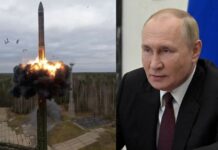
At dawn on February 24, Russian President Vladimir Putin, who had massed more than 150,000 troops around Ukraine in recent weeks, announces a “military operation” in Ukraine to defend self-proclaimed separatist “republics” in the east of the country. country, whose independence it had recognized three days earlier.
In retaliation, Western countries ordered a battery of increasingly severe economic sanctions against the Russian economy and financial sector. To date, some 330 companies have announced a stoppage of operations in response to the Russian invasion of Ukraine. Some have even gone further and have announced their definitive departure from Russia.
Stunned, many Muscovites discover the magnitude of the international response to the Russian military intervention in Ukraine when they see the closed doors of the department stores where they used to buy clothes and furniture.
Zara, Ikea, McDonalds, Starbucks, Apple… all suspended their operations in Russia from one day to the next and closed their stores in the many shopping centers of the Russian capital.
In the last 40 years Muscovites have lived through many periods of crisis, scarcity and hyperinflation, but the last two decades under Vladimir Putin represented for many an era of prosperity and access to consumer goods.
Russian authorities stress that the country will quickly recover from international sanctions imposed since February 24, but many residents are expecting gloomy days.
Iulia Shimelevitch, 55, who gives private French lessons, goes to a pet food store looking for Western products for her dogs and cats.
In 10 days, most of his students canceled their classes, many of them chose to leave Russia in the face of repression and the difficulties that lie ahead. His son will join the exiles on Sunday.
“My life is falling apart,” he laments. “All the luxuries that I was used to in recent years, the imported products, the clothes, it seems to be a thing of the past.”
“But the hardest thing will not be to tighten the belt but to separate myself from my son and the feeling of guilt with respect to the rest of the world,” he summarizes.
A cascade of big brands, from various sectors and that were a symbol of Russia’s opening to Western capitalism, have decided to stop their operations in that country and face the millionaire losses. McDonald’s, for example, said Wednesday that the temporary closure of its 847 stores in Russia will cost it about $50 million a month.
The fast-food chain itself operates 84% of its stores in Russia and said it will continue to pay all of its 62,000 staff and restaurant employees there. Other costs will come from the premises it rents and from supply chain operations, Chief Financial Officer Kevin Ozan said during a UBS conference on Wednesday.
“This is a really challenging and complex situation for a global company like us,” he said.
In addition to McDonald’s, an icon of the post-Soviet era, these are other emblematic companies within the capitalist economies of the West that have decided to close the door to the Russian market. At least for now.
Food and drinks
Coke and PepsiCo
The American soft drink company Coca-Cola announced in a brief statement that it is suspending operations and will continue to evaluate the situation and the course of events.
“Our hearts go out to the people who are suffering the horrific effects of these tragic events in Ukraine,” the Atlanta-based company said. Georgia, in the United States.
Its great competitor, PepsiCo, could not stay on the sidelines and shortly after announced that it would suspend the sale of all its soft drinks (Pepsi and Seven Up, mainly) and products in Russia, although it does not close its plants because its business includes a factory of dairy products that employs 20,000 people and another 40,000 ranchers in the supply chain.
“We have been operating in Russia for more than 60 years and have a place in many Russian homes. Pepsi-Cola entered the market at the height of the Cold War and helped create common ground between the United States and the Soviet Union,” wrote his CEO, Ramon Laguarta, to emphasize what his decision means, although he acknowledged that the situation could not continue unchanged “given the horrible events” in Ukraine.
Starbucks
The company, which reiterated its condemnation “of the horrible Russian attacks in Ukraine”, announced that it is suspending all its activities on Russian territory and advanced that, as the situation evolves, it will continue to take measures that are in line with its “values”. .
Starbucks, which although it has more modest figures (170 stores, according to Statista, and 2,000 employees) is also another powerful symbol of capitalist globalization with its coffee shops that are usually always located in the busiest parts of the main cities.
KFC
Yum Brands Inc, parent of fried chicken giant KFC, said it was pausing investments in Russia, a market that helped it hit a record high last year.
Clothing
Levi’s
Levi Strauss on Monday suspended the sale in Russia of his clothing, including his legendary jeans, often considered a symbol of the United States, thus joining a growing list of companies that stop operating in the country after the invasion of Ukraine.
“Considering the enormous disturbances in the area, which do not allow business to be carried out normally, (Levi Strauss) temporarily suspends its commercial operations in Russia, including any new investment,” the US group detailed in a statement.
The group’s activities in Eastern Europe accounted for 4% of total turnover in 2021, half of this percentage from operations in Russia.
Inditex
The textile firm reported in a statement that it would temporarily suspend its activity in the 502 stores (of which 86 are Zara) and in the country’s online channel. This is because “under the current circumstances, it cannot guarantee the continuity of operations and commercial conditions in the Russian Federation.”
Russia constitutes around 8.5% of the group’s global EBIT, a weight that has only increased in recent times. As the company explained to the National Securities Market Commission (CNMV), “all stores operate on a rental basis, so the investment is not relevant from a financial point of view.”
Inditex “continues to prioritize its workforce of more than 9,000 people, with whom it is going to develop a special support plan from now on”. In 2019, the company had almost 10,700 workers in that country.
Technology
Apple
Apple announced that it would stop all sales of its products in Russia and limit the use of the Apple Pay payment solution and other services in the country.
“We are deeply concerned about the Russian invasion of Ukraine and we stand with all those who are suffering as a result of the violence,” Apple said.
Ukraine’s warring government, urging its citizens to battle Russian forces, has appealed to all quarters for help, including Apple boss Tim Cook.
“I appeal to you… to stop supplying Apple products and services to the Russian Federation, including blocking access to the Apple Store!” Ukrainian Minister of Digital Affairs Mykhailo Fedorov wrote in a letter posted on Twitter on Friday.
Samsung
Samsung Electronics has suspended its shipments to Russia due to current “geopolitical developments”, the company said on Saturday, as other major companies such as Apple cut ties with Moscow over the invasion of Ukraine.
The South Korean tech giant is Russia’s largest semiconductor maker and leader in smartphone sales.
“Due to current geopolitical developments, shipments to Russia have been suspended,” Samsung said in a statement. “We continue to actively monitor this complex situation to determine our next steps,” he added.
Samsung controls just over 30% of the smartphone market in Russia, according to Bloomberg News, accounting for 4% of total smartphone profits for the South Korean giant.
Microsoft
The US computer giant Microsoft announced this Friday that it is suspending new sales of its products and services in Russia, thus joining other companies that adopted similar measures, after the Russian invasion of Ukraine.
“Like the rest of the world, we are horrified, outraged and saddened by the images and information coming to us from the war in Ukraine and we condemn this unwarranted, unprovoked and illegal invasion of Russia,” said Brad Smith, president of Microsoft. it’s a statement.
Smith added that Microsoft is ending “many aspects of [its] activities in Russia in accordance with sanctions decided by governments,” but did not go into detail.
Entertainment
Disney
The Walt Disney Company announced that it was proceeding to suspend all releases in Russia, including the Pixar film Turning Red , which was scheduled to be released in the country on March 10.
Netflix
Netflix is going to suspend all the projects it has in Russia as a result of the invasion of Ukraine. The decision of the streaming platform occurred after it refused to broadcast Russian propaganda, it had been obliged to do so since March 1 since it belongs to the registry of audiovisual services.
Netflix currently had four Russian original projects in the works, including a crime thriller series directed by Dasha Zhuk that was already being shot. But filming has already been suspended.
Spotify
The streaming music giant announced on Wednesday the closure of its office in Russia and limitations on access to content published by Russian state media in response to the “unprovoked attack on Ukraine.”
“We have closed our office in Russia until further notice,” the New York-listed, Stockholm-based company said in a statement.
In addition, the streaming giant indicated that it had analyzed “thousands of podcast episodes since the beginning of the war” and had limited the ability of users to find programs produced by media linked to the Russian state.
Furniture
Ikea
The Swedish furniture chain reported that it will close its stores in Russia and suspend all purchases in the country and in its ally Belarus.
“These decisions have a direct impact on 15,000 Ikea employees. The ambitions of the business groups are long-term and we have ensured employment and income stability for the immediate future and we provide support to them and their families in the region”, detailed the company.
The company shared in a statement that Inter Ikea Group will also suspend all exports and imports into and out of Russia and Belarus. In addition, to pause all production operations of Ikea Industry in Russia, which means that all deliveries from all sub-suppliers to these units are on pause.
Toys
Lego
The Danish company that produces blocks announced the temporary suspension of the shipment of products to Russia due to trade sanctions imposed by several Western countries as a result of the war in Ukraine.
“We have suspended the transportation of our products to Russia due to the effect of sanctions and the unpredictable environment for operating,” the company said in a brief statement sent to several Danish media today.
credit card issuers
Visa, Mastercard y American Express
American credit card companies announced the suspension of their operations in Russia due to its invasion of Ukraine.
“In light of Russia’s ongoing unwarranted attack on the people of Ukraine, American Express is suspending all operations in Russia,” American Express said in a statement on Sunday.
“We are also suspending all business operations in Belarus,” he added.
A day earlier, Visa and Mastercard announced a similar move. Mastercard said it had decided to “suspend network services in Russia,” “taking into account the unprecedented nature of the current conflict and the uncertain economic environment.”
For its part, Visa indicated that it will work “immediately” with its “customers and partners inside Russia to stop all Visa transactions in the coming days.”
“We are compelled to act following Russia’s unprovoked invasion of Ukraine and the unacceptable events we have witnessed,” Visa CEO Al Kelly was quoted as saying in a statement.
“Our colleagues, our customers and our partners have been affected in ways most of us cannot imagine,” Mastercard said on its side.
Russian Visa, Mastercard and American Express bank cards will no longer work abroad, while those issued abroad will no longer work in Russia.
In recent days, the three firms had taken steps to prevent Russian banks from using their networks, in application of international sanctions decided after the Russian invasion of Ukraine.
An opportunity for Russian companies?
Putin has repeated that the sanctions must be an opportunity for Russia to increase its own production.
Perhaps it may be possible in the agri-food or textile sector, where progress has been made in recent times, but it will be more difficult in the technology sector.
On the Kuznetski Most shopping street, where shops are now closed, Tamara Sotnikova, 70, says she cares little about the sanctions.
“Everything must come from here,” he says. “In Soviet times, what was there? Nothing! And we lived normally, quietly,” he ditches.
With information from Reuters and AFP