

London brought together the foreign ministers of the G7 countries for the first time in two years in person, in a meeting to agree on joint responses to global threats and the recovery from the coronavirus pandemic. A meeting that laid the foundations for the leaders’ summit scheduled for June in Cornwall. The representatives of the members of the group – the United Kingdom, the United States, Canada, France, Germany, Italy, Japan and the European Union – began dialogue sessions, in the face of the growing “challenges and threats”, in a direct reference to Russia and China. , which they identify among the main threats to that global order. The United Kingdom has wanted to use the presidency of the G7 to enhance its international profile in any case, since its departure from the European Union, with this previous three-day meeting in London to which Also attending are the headlines from India, Australia, South Africa and South Korea, a gesture that underscores the geopolitical importance that the Indo-Pacific region has assumed. G7 leaders stressed, at this summit, the need for a common position to deal with global threats, in contrast to the growing unilateralism of recent years and the decline of global institutions. The withdrawal from Afghanistan, relations with Iran, the future of NATO, the war in Syria and the actions of the military regime are some of the topics on the table at the G7 meeting, with the post-COVID recovery as a backdrop, and With Russia and China as the main protagonists, the meeting took place in a context of increasing pressure to show more solidarity.The spread of the virus has also exacerbated gender inequalities, underlined the representatives of the group, who have agreed on measures to finance initiatives that facilitate the incorporation of women into the world of work, as well as to improve the education of 40 million girls in the next However, there was no announcement about new funding to improve access to vaccines, despite repeated calls for the G7 to do more to help the poorest countries. Several activists have urged the G7 to redouble its efforts to tackle glaring inequalities in the fight against the coronavirus pandemic, as Western countries step up vaccination campaigns and reopen their economies. Recovering from the coronavirus pandemic requires more than ever to preserve the current system of international norms, the G7 foreign ministers stressed in the conclusions. The G7 foreign ministers reserved their harshest criticisms of China and Russia, which they called to comply with. with its obligations under national and international law. Two countries with which there are shared interests, but which pose important security problems. Relations between China and the United States deteriorated dramatically during the era of former President Donald Trump with friction on levels such as commercial, diplomatic or technology, and while Biden has promised another approach, his government appears in no rush to put an end to its conflicts with Beijing altogether.As soon as this meeting began, one of the first since Joe Biden arrived at the White House, the Secretary of the United States, Tony Blinken, wasted no time and openly accused Beijing of carrying out cyberattacks, of violating the rights of the Muslim minority of Xinjiang province, Hong Kong city dwellers and Taiwan and Beijing practices that go against “free and fair economic systems”, particularly in the fields of “trade, investment and development finance “, as well as support for” theft of intellectual property. “Regarding the erosion of human rights in Russia, they also occupy a prominent place in the concerns of the countries of the group, which criticize the” systematic repression of opposition voices ”, activists, members of“ independent ”civil society and journalists. They also condemn the “irresponsible” and “destabilizing” actions of Moscow on the border with Ukraine, as well as the “malicious actions” of the Russian Government to try to destabilize third countries and its use of “disinformation”. Efforts to demilitarize Libya and the December elections in that country also occupy the attention of ministers, as well as the situation in Syria and its neighboring countries. In this regard, the G7 ministers aspire to pressure Russia on humanitarian assistance in the region.During the first day of the meeting in London, Borrell and Blinken addressed in a bilateral meeting on the margins of the G7 ministerial summit in the one that discussed the nuclear pact with Iran. Both diplomats analyzed ways to ensure a “full and effective implementation” of that agreement.The two ministers spoke of the common interest in achieving the release of their citizens imprisoned in Iran, with special mention to the Iranian-British citizen Nazanin Zaghari-Ratcliffe, after five years in prison accused of espionage In addition to China, Russia and Iran, The foreign ministers threatened the Burma coup junta with new sanctions on Burma. The diplomats meeting in London are expected to urge the military regime that has taken control of the country to cease its activity in their conclusions. During the day, measures to control the entry of arms and limit the financial flows of the ruling junta were analyzed. The seven powers, however, left the door open to future cooperation and stressed the need for a common position to face global challenges. , in contrast to the growing unilateralism of recent years during Donald Trump’s term in the United States.
The G7 calls for unity in the face of global threats

The G7 promises to deliver 2.3 billion vaccines to developing countries by 2022
The Group of Seven (G7) made up of Germany, Canada, the United States, France, Italy, Japan and the United Kingdom has committed to delivering 1 billion vaccines to developing countries over the next 12 months with a view to a total, as anticipated by German Chancellor Angela Merkel, of 2.3 billion vaccines by the end of 2022.
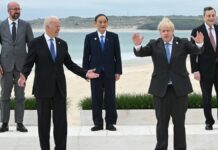
The G7 agrees to donate one billion vaccines to poor countries
The Group of Seven (G7) has reached an agreement so that the world's poor countries can receive 1 billion Covid-19 vaccines
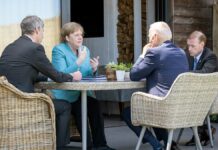
Biden and Merkel meet for the first time during the G7 summit
The Chancellor of Germany, Angela Merkel, and the President of the United States, Joe Biden, held a bilateral working meeting this Saturday, taking advantage of the Group of Seven (G7) summit held in Cornwall, United Kingdom.
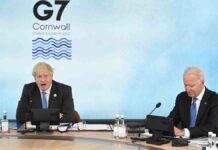
The G7 will present its action plan against future pandemics
The members of the G7 meeting in the United Kingdom will present during the summit the action plan for future pandemics such as Covid.

The G7 reaches a “historic” agreement on a minimum tax on large companies
The bloc committed to a target of a global minimum corporate tax rate of "at least 15%".