I was with Lucas Villa on the viaduct, I said goodbye around 6:30 pm I didn’t see him anymore, only when in a video, with his same strength and eloquence, he continued to raise his voice. This was the last thing that came out of his mouth, after proclaiming pacifism and love: “The stubborn, the sleeping one, wake up.”
The year Lucas Villa was born, 1984, the world was in decline, not only of walls but of ideologies. The day he was killed, the country was in the midst of riots and uprisings. In Colombia, 37 years ago, there was another massacre: at the National University, the police attacked students for protesting the murder of the student Jesús “Chucho” León, and at least six students, according to the student publication May 16, were murdered. Lucas Villa Vásquez lived between the pain of one murder and the other, until his last day: “They are killing us.” The words he said on the day of his fatal culmination go around the world and the reactions to his murder have been: “They killed us joy”, “the soul of the university died”, “they gave us in peace.” Villa was born as a seed. He traveled the world, not with his personal dreams or those of his family, but with those of an entire nation. His father, in an interview, said: “We wanted to run together in a triathlon.”
We suggest: Tribute to say goodbye to Lucas Villa at U. Tecnológica de Pereira
The night before leaving, Villa sent a message to a friend saying: “If it’s time to go, it’s time to go. There is no other, we have to face that. May the spirit guide us and take care of us so that we can survive and create a new world ”. On May 5, he groomed his beard very well. That day he dressed in a red scarf, blue shirt (from Star Wars), white pants and comfortable tennis shoes (which he used to jog), as well as the ideas he always had and the desire that he never ceased to enliven: the need to educate . That is why he got on the buses to tell people the reasons for the national strike. To Mauricio Gallo, his professor of the Sports and Recreation Sciences career, he also announced that he had to go out “to take care of people”.
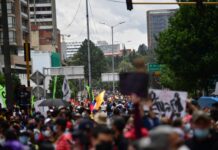
That day, Villa was surrounded by an aura of eloquence. I marched with him, like thousands of other people, since it was a call for a cultural carnival, where artists from all backgrounds expressed themselves with dances, music, performance , poetry and theater. He danced capoeira at Parque Olaya Herrera, where the crowd raised their arms and made a minute of silence for the missing, wounded and murdered. He also joyfully chanted the national anthem. I saw him approach, and I recorded him, giving his fist and hand to policemen from a squad who were friendly. He told them that they are warriors and heroes, and continued on the march with fervor.
As he moved on, he was not without enthusiasm. He sang, touched my arm, smiled and said: “Professor, in this we are more united.” He was right, there was no such precedent in the city of Pereira, as up to five marches came out from different places and various programs promoted by the indignant people took place. He climbed on railings and later screamed for life: “First things first: health and education.” He was until the last moment being what he always was: an enthusiast. At the Viaduct – which connects Dosquebradas with Pereira – he thanked the people who came with food. He shared with young barristas, spoke to them about his country, about the importance of fighting and organizing. He did not stop raising his voice with power. In the audio, his friend is heard saying: “The worst can happen. All for all ”.
 Follow the news of El Espectador on Google News
The horror sequence is not new in Pereira. Juan Miguel Álvarez, in a report entitled Tiros de gracia , narrated how several people (especially street dwellers) have been killed with the weapons and skills of professional people. At the time it was read on the walls: “Good children go to bed before 11, the rest, we put them to bed.” What had never happened in the sixty years of the existence of the public university is that people who decided to march were murdered.
You may be interested: “In Colombia we have a war against memory”: Ariel Camilo González
It is not fortuitous that in the midst of the cultural mobilization, and even minutes before the bullets destroyed his humanity, Villa was marked with a green laser. Two days later, I returned to the viaduct and a worker from one of the companies in the area told me that he had helped lift his body: “They shot him from a blue motorcycle.” It is also “curious” that on the previous nights of the demonstration the place had lighting and that night it did not. The shots were heard around seven past. “I saw the 9 mm pistol casings,” said the worker. Nor do the videos of the cameras that may have recorded the event appear, according to the prosecutor in charge of the case, “because they are damaged.” He also told me that “it is important that people report and deliver evidence.” In a conversation with her, and with the staff of the Prosecutor’s Office, I told her about the number of injuries and that just at the same time, two days later, another young man was murdered in the protests: Héctor Fabio Morales, whom he told her from another motorcycle. they silenced life. In an audio, his mother is heard saying: “I saw Gildardo Castaño, Pizarro buried and now it’s your turn.”
Villa was a 10th semester student. Those who were with him speak of his intelligence. One of them told the station of the Technological University of Pereira: “We got to know each other better on the outings. Lucas, in the middle of a long walk, encouraged us and encouraged us to continue ”, he seemed tireless. In addition, he was always restless: he did some years at the Merani School, he studied Cinema at the National, but he did not finish it, then he was an adventurer, he met paradises in Latin America, but it seems that what most caused his transformation was Hinduism. He was a yoga teacher and guided many ceremonies. Anything he did was impacted by his social conscience, so much so that he preferred not to eat violently. He liked fruits and vegetables, and when he ate, he offered a blessing or thanked for the food. Lucas loved his country and was attached to life, his breathing revealed an overflowing passion and creativity that left everyone very restless. “He was the one who made the difference, and even if the classes were boring, with his questions and interventions, he made them motivating.” His average was 4.5. In addition, he always rode his bicycle, as an act of promoting physical activity and respecting the planet without polluting.
Professor José Miguel, a polyglot close to Lucas, with whom he traveled trails, mountains and landscapes, says: “He was passionate about sports, he had an enviable physical condition, he was also passionate about pedagogy”. In addition, he comments that he “guided him with his light” and that he worked to help raise his younger siblings.
Mauricio Villa, her father, says that one of his daughters, who is a geologist, has not been able to get a job. The single figure of 14.2% of Colombians in unemployment, between March 2020 and March 2021, and the one related to the fact that the population in poverty went from 17.4 million people to 21.2 million in 2020, according to studies by the DANE, in addition to alarming, has the country shaken. In addition, as I write this, there is the testimony of a girl who was raped and tortured in Popayán, who later committed suicide, a fact that is added to the at least 16 complaints of sexual violence allegedly exercised by the Public Force, as recorded by the organization Tremors. There is also an account of at least 30 people who have been attacked in their eyes during the demonstrations of the national strike.
We suggest you read: Cali: protest, art and dignity
From the front-line barricades, the hint of abandonment has become evident. Some of the boys have confessed to me that they have eaten better these days and that people have supported and embraced them. They have told me that they have felt affection that they did not have at home before. They have made murals for Lucas and his way of life, as well as what he said, is known to thousands of people. “We are news, but we will not stop until we are history,” reads a poster of a protester.
“In peace, boys,” he sentenced the crowd after the act of greeting the policemen. Not only did he do it, others also approached, also with a banner that read: “Where did the love with which you swore to defend your people shouting ‘God and country’ went”. Lucas was a pacifist. Professor Carlos Alfonso Victoria says it best: “One day he was bitten by one of the university’s dogs. His reaction was to think that the dog was hungry and he bought him food, and told him to reconcile ”. On May 5, he raised his fist several times. The phrase from the hymn “Oh immortal jubilation” was uttered with shocking vehemence. On May 12, his family went out to the demonstrations, and among several of the tributes made to his name, a permanent one has been to send beautiful vibrations and energies to the universe, practicing yoga. Among the marchers, Lucas’s brothers carried a cloth and with letters written in blue they left the message “We are the revolution of love, Lucas lives!”.
He showed his dad the videos where he clowned. His creative force was to “help people who had traumas from their childhood.” In those works he said another phenomenal phrase: “See you on the road.” The path of his life, like when he crashed on a bicycle and was close to death, helped him understand that he could not just go like this. He sensed that he was going to live great moments and the national strike had him on alert. While he was supported by a respirator and various sedatives at the San Jorge hospital, I was talking with several doctors. In addition to mentioning the reserved diagnostic opinion to me, his explanations were not very hopeful: “He is no longer a candidate for anything,” “he has stem reflexes” “he is convulsing a lot”. Throughout those seven days he spent there, chains went out to discredit his name: “He was a gamin” and “he is a good dead man”, were some of those messages.
“After the pain, a new dawn will come”, was the phrase that the family placed at the funeral. The songs, the messages, the ways of enunciating, both of the student body and of the population in Pereira, in Colombia and in the world, have been to welcome Lucas’s message of peace, his overwhelming joy and his ability to put himself in the instead of others. The rectory of the university, of Luis Fernando Gaviria, decreed three days of mourning and the teachers in assembly have demanded justice. The dean of the Faculty of Health Sciences, Patricia Granada, in an emotional letter, wrote: “Your life, always young, will be a perennial tribute to the university student who raises his voice dancing and teaching that freedom is a right already earned. which is worth fighting for ”. The representative of the students of the program that Lucas studied, Juan David Mesa Montoya, also spoke: “Lucas proclaimed in his talks, conversations and academic interventions love, peace, the gift of service to others; he and nature are the same, because he had a magical way of connecting with everything that springs from the earth and the beings that inhabit it ”.
You may be interested in a text related to the role of the arts in social protest: The arts take the lead in the street
Lucas’s family has now received threats. The Esmad’s presence outside his funeral was annoying. A recognized lawyer told me that the special unit should be where there were crowds and possible riots. I replied that the funeral ceremony has been known as an act of respect and honor to life, as well as reconciliation. Lucas had donated his organs long before he died.
Fernando Zapata, environmentalist and trochero, told me: “We went to the Santa Isabel snow-capped mountain and there was no other like him. He would climb the trees, at mealtime there was no one to stop him, he made us laugh, one enjoyed a lot with him ”. Lucas Villa had the spirit in the mountains, his peace in yoga and the dimension of light he shared with the people. He lived with his wife and lived close to the university. Neighbors have remembered him with the words he used to say on posters: “At this moment you can connect with the love of a nation, let’s try to do that, it is the only way, because we are about to experience the most painful thing we have ever experienced and we can still stop it, and that’s what it’s all about ”.
His path was that of good and good living. To the downcast, he gave words and desire, with whom he wanted, he argued and fought with language, but at the same time he healed. He offered reiki classes and gave a lot of advice. A cartoon puts him in the dimension with Andrés Caicedo, the writer, and with the humorist Jaime Garzón. The first committed suicide and the second was also murdered. In the midst of the strike and the blockades in Pereira, and given the situation, the mayor of the city, Carlos Maya, called for the formation of civil groups to safeguard order to face a common front with the authorities. The citizens have told him that the hundred million pesos offered by those responsible do not speak of a price, but that life has value. As Dr. Granada says in her letter: “Your departure to a higher plane leaves your footprints on this material plane in your harangues, which are the voice of a people burdened by poverty, by the loss of their leaders killed by inequality and social injustice (…), looking for a little hope ”.
“The barbuchas was a great athlete, an excellent swimmer, cyclist and yogi, and a runner not to mention it. It was a running horse, it was pure energy, always on the move ”, postulates Professor Mauricio Gallo. The days go by, the young barrista who was also shot, and is 17 years old, improves. Andrés Felipe Castaño is one of those who went from shouting a goal and having team choirs, to shouting “justice”. He was happy because the bars were united and building a country.
I was with Lucas on the viaduct, I said goodbye around 6:30 pm I didn’t see him anymore, only when in a video, with his same strength and eloquence, he continued to raise his voice. This was the last thing that came out of his mouth, after proclaiming pacifism and love: “The stubborn, the sleeping one, wake up.” Seconds later he was shot eight times.