Among many other things, Homo sapiens are characterized by our great sexual appetite and by a highly developed talent for annihilating other species, either directly (with violence) or indirectly (eating the ground until they lead to extinction).
Neanderthals and Denisovans knew something of this, two human species with whom, according to genetic tests, we had sexual relations before they vanished, swallowed by ruthless natural selection.
Now, a new unknown human species comes to join this cocktail of primitive sex whose tracks can be traced in the present, thanks to the fact that those encounters produced fertile descendants who passed on their genes.
Sex, proteins and coding genes
Researchers from the University of Buffalo (United States) have discovered in a protein in the saliva of some current sub-Saharan populations evidence that suggests that Homo sapiens mixed with a still unknown primitive human, a “ghost man” of which no fossil records are known , but that had to be there, if the genes don’t lie.
According to Omer Gokcumen, professor of Biological Sciences and one of the authors of the work, “it seems that the crossing of different species of early hominins was not the exception, but the norm. In our research we have traced the evolution of a protein called MUC7, which it is found in saliva. When we analyze the history of the gene that encodes this protein, we find archaic features present in some of the current inhabitants of sub-Saharan Africa. “
This discovery reinforces recent studies that, through genome sequencing, have also found evidence of mixing between Neanderthals, Denisovans and primitive sapiens that left their mark on modern humans in other African regions. The same phenomenon would have happened in Europe and Asia.
The snitch MUC7
The MUC7 protein, key in this research, is important because it provides saliva with enough viscosity to trap microbes, which allows the body to expel them and avoid potential diseases.
Gokcumen and his colleagues became interested in this protein because a previous study had established that the gene that encodes it (which we will also call MUC7) varies between different populations, and that this variation is relatively easy to track.
The researchers analyzed this gene in the genome of more than 2,500 modern humans, and they were surprised: a group of individuals from sub-Saharan Africa possessed a different version of the gene from the rest. The sub-Saharan variant was so distinctive that it fitted less with that of today’s Homo sapiens than that of Denisovans and Neanderthals.
Walks from 150,000 years ago
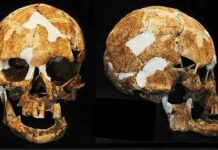
According to Gokcumen, “the most plausible explanation for this extreme variation is the introduction of genetic material from a ghost species of archaic hominin, which may or may not be a subspecies of Homo erectus . We call it a ghost because we don’t have its fossils.”
Given the rate at which genes mutate during evolution, the researchers calculate that the ancestors of people who today carry the sub-Saharan variant of the MUC7 gene intermingled with another human species about 150,000 years ago, after the evolutionary path of both branches. of humanity diverged sometime between 1.5 and 2 million years ago.
Photo: Bob Wilder / University at Buffalo