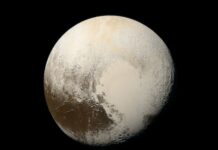
The Voyager 1 probe, the furthest human-made object from Earth, could have reached interstellar space after passing the orbit of Pluto . The University of Maryland study affirms that this happened just over a year ago, which contradicts the information recently offered by NASA that placed the spacecraft still in the heliopause, a transition zone between our Solar System and the rest of the world. the Galaxy.
The scientists argue that, due to the decrease in the flow of solar particles and the change in the direction of the magnetic field, the probe is already outside the heliopause. On August 25 of last year, the probe detected these fluctuations for the first time, so the researchers place their departure on that date. However, NASA takes this new theory with caution, since it is based on the hypothetical conditions of matter and energy of the interstellar medium.
The Voyager 1 probe has been exploring our Solar System for 36 years together with its twin probe, Voyager 2, and it is estimated that its mission will last until 2020. Its technology, which in computing aspects can be considered obsolete, nevertheless stands out for its formidable longevity.