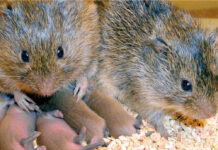
Theowl monkeys ( Aotus ) that have a stable mate and are faithful to itreproduce more than those with multiple partners, according to a study by the University of Pennsylvania (United States), published inPlos One. Work revealshow monogamy and mating, relatively rare among mammals, can benefit hundreds of individuals. And it could help to understand how the patterns of relationships in humans have evolved, as pointed out by the anthropologist Eduardo Fernández-Duque and his colleagues, who since 1997 have monitored a population of owl monkeys in the Chaco region of Argentina.
His observations of the behavior, demographics, and physiology of 18 groups of owl monkeys (154 animals, total) over 16 years, show that these primates typically live in monogamous groups consisting of an adult male, an adult female, and their offspring. . Young people disperse from the group around 3 or 4 years.
In 2008, Fernández-Duque and her colleagues published an article reporting, for the first time, the presence of an individual so-called “floater,” which attacked the male of a couple and essentially replaced him as a partner and child care provider. The team has now shown that this usurpation of their teammates is a fairly common occurrence. Replacements often come with dramatic fights, which often end badly for the “sent off.” And research reveals, having an expelled partner or partner harms the reproductive success of the remaining partner. “What we concluded is thatif you manage to be with the same partner in the long term you can produce more offspring than if you are forced to change partners“Exposes Fernández-Duque.” Monogamy makes sense for these primates, because in faithful couples the males are sure of their paternity and invest in caring for the young, “he adds.
According to the researcher, there is a certain consensus among anthropologists thatthe formation of couples must have played an important role in the origin of human societies. Call it love, call it friendship, or call it marriage; but there is something in our biology that leads to thislasting emotional bond between two peopleand that it is very widespread among human societies. “