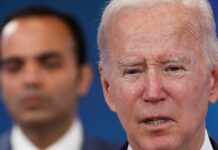
US President Joe Biden announced on Thursday the donation of 80 million anticovid vaccines to be distributed globally, 75% of which will be distributed by the Covax program in regions such as Latin America.
“We share these doses, not for favors or concessions. We share these vaccines to save lives and lead the world to end the pandemic with the power of our example and our values,” Biden said in a statement.
The White House on Thursday unveiled a plan for the United States to share 25 million surplus doses of the COVID-19 vaccine with the world and said it would lift some restrictions to allow other nations to more easily buy domestically made supplies for the vaccine production.
This was stated at a press conference by the White House spokeswoman, Jen Psaki, who specified that “there are 25 million doses that will come out as soon as possible, very quickly, some of them will even come out as soon as today (the Thursday)”.
This will be the first time that the United States shares with the rest of the world vaccines approved for internal use – those of Moderna, Pfizer and Johnson & Johnson -, since it had previously announced the shipment between May and June of 60 million doses of AstraZeneca, which has not yet received the go-ahead from US regulators.
The United States will donate nearly 19 million doses through the multilateral COVAX scheme, Biden said in a statement. Through COVAX, about 6 million doses would go to Latin America and the Caribbean, about 7 million to South and Southeast Asia, and about 5 million to Africa.
The remaining doses, which amount to just over 6 million, would go directly from the United States to countries such as Canada, Mexico, India and Korea, he said.
The United States wants to “maintain some flexibility” on assigning doses outside of Covax’s formula as needed, National Security Advisor Jake Sullivan explained.
“Partner and neighbor”
US Vice President Kamala Harris called Mexican President Andrés Manuel López Obrador on Thursday to inform him that his country will soon share vaccines with the Latin American nation, Harris spokeswoman Symone Sanders said earlier.
According to Biden, Mexico will receive these vaccines for being a “partner and neighbor” of the United States.
“We spoke with Vice President Kamala Harris. She was kind enough to inform us, prior to the announcement in the United States, of the decision to send us one million Johnson & Johnson single-dose vaccines. I expressed our appreciation on behalf of the people of Mexico.” López Obrador wrote on Twitter.
The government of Mexico indicated this Friday that it will allocate these vaccines, plus 1.9 million more doses purchased on its own, for the 40 municipalities on the border with the United States, and thus be able to open the border crossing soon.
“(The objective is) for vaccination in Mexico to advance to degrees or proportions similar to those in the United States, therefore expediting or accelerating the reopening of activities on the border between Mexico and the United States,” explained the Mexico’s Foreign Secretary, Marcelo Ebrard, at the president’s daily morning conference.
Although Hugo López-Gatell, undersecretary of Prevention and Health Promotion, had said this Thursday that the doses would go to areas with an increase in covid-19 cases and tourist sites, such as Quintana Roo, the Foreign Minister clarified this Friday that the goal is the northern border, which is closed to non-essential travel as of March 21, 2020.
“We think that with this, there would already be all the sanitary conditions so that the United States can agree to the resumption of activities, if not all the great majority, and then the economic, commercial and personal impact that has been in the border area will not be maintained” , argument.
Mexico has already received 2.72 million AstraZeneca vaccines from the United States between the end of March and the beginning of April.
Harris also spoke on separate calls Thursday with Indian Prime Minister Narendra Modi; the President of Guatemala, Alejandro Giammattei, and the President of the Caribbean Community (Caricom) and Prime Minister of Trinidad and Tobago, Keith Rowley.
The Guatemalan president reported that Harris informed them of the arrival of half a million vaccines, without giving further details. With 18 million inhabitants, Guatemala has so far one million doses of AstraZeneca, Moderna and Sputnik V.
Harris will be on Sunday and Monday in the Central American nation, and on Tuesday in Mexico. In both cases, the immigration issue will be high on the agenda for meetings with local authorities, although there are thorny issues that may also be discussed.
A necessary step
International organizations, such as the United Nations and the World Bank, welcomed the announcement. “It’s a good start and I hope more doses are available,” World Bank President David Malpass told Reuters.
The director general of the WHO, Tedros Adhanom Ghebreyesus, said he was “very grateful” for the initiative, while the head of the Pan American Health Organization (PAHO), Carissa Etienne, urged other countries with surplus vaccines to follow ” the example of the United States “.
Etienne recalled that in Latin America and the Caribbean only 4% have completed their inoculation scheme and said that the region, “the epicenter of suffering from COVID-19, should also be a vaccination epicenter.”
Costa Rican President Carlos Alvarado, who this week received the head of US diplomacy, Antony Blinken, on his first trip to the region, celebrated “President Biden’s plan to provide more vaccines against COVID-19 globally and strengthen the Covax mechanism. “
Also India, one of the countries hardest hit by the pandemic, expressed its gratitude.
“I deeply appreciate the guarantee of supply to India as part of the US strategy,” Prime Minister Narendra Modi said after speaking with Harris.
And while some thanked, others, such as Venezuelan President Nicolás Maduro, regretted not being included in the cast.
“Miserable! Miserable, they not only persecute so that they do not sell vaccines to Venezuela, but also when they can open their rotten hearts to show their misery and their hatred against Venezuelans,” Maduro accused.
The US ambassador to Venezuela, James Story, who is based in Bogotá, since Washington and Caracas lack relations, explained that the exclusion is due to the fact that the country “lacks transparency in the delivery of vaccines to the people in need.”
The White House is also eliminating the special powers it granted through the Defense Production Act (DPA) to certain vaccine manufacturers that received funding from the United States but do not yet have approvals from the country. including AstraZeneca, Sanofi SA / GlaxoSmithKline Plc, and Novavax Inc.
DPA ratings give US producers priority access to the supplies and equipment needed to make the vaccines that are in short supply around the world. Lifting them could free up raw materials for major vaccine manufacturers elsewhere, especially the Serum Institute of India (SII).
There is great inequality in the distribution of vaccines in the world, where for example the abundance of the United States contrasts with the scarcity of India, which has become the epicenter of the pandemic.
Specifically, 87% of the doses have been administered in high- and middle-income countries, while impoverished nations have received only 0.2%, says April data from the WHO.
Through Covax, 80 million doses have already been delivered in 127 countries and territories. 97% are from the AstraZeneca vaccine, not yet authorized by the United States health authorities, and the rest from Pfizer-BioNtech.
PAHO, which facilitates the acquisition of Covax vaccines in the American continent, said that so far, more than 18.9 million doses have been sent through this mechanism to 31 countries in the Americas.
With information from AFP, EFE and Reuters