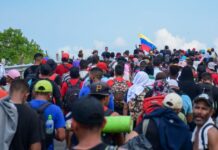
With more than 3,800 deaths per day, South America is the region that is suffering the most from the second wave of the coronavirus worldwide. Paraguay, Argentina, Brazil, Colombia, Uruguay, Bolivia, Peru and Ecuador continue to lead the global ranking of countries that have been registering more new deaths in relation to their population.
However, a country in the south of the continent seems to remain oblivious to the drama of its neighbors. Venezuela continues to report much lower levels of both infections and deaths compared to the rest of Latin America fifteen months after the start of the pandemic. In fact, the country accumulated 101.4 deaths per million inhabitants until June 16, a level 19 times lower than the average for South America and 17 times lower than that of Mexico.
That health success, which President Nicolás Maduro often boasts in his speeches, is facing, however, more and more questions. “Although it is true that in Venezuela the virus has behaved less aggressive than in neighboring countries, there is an under-registration of between 30% and 40% of both cases and deaths,” says Huníades Urbina-Medina, secretary of the National Academy of Medicine, in Caracas.
“Doctors who complete the death certificate are only authorized to indicate the coronavirus as the cause of death if the patient underwent a PCR test, and, as practically no tests are being done, there are many diagnoses of death that are not reported as coronavirus, although clinically and epidemiologically they do correspond to that disease ”.
No evidence
Without official information on the number of tests carried out in the country, the Doctors for Health network estimates that only between 4,000 and 5,000 PCR tests are carried out per day, a very low level for a population of close to 29 million people.
“80% or 90% of the patients who are in hospitals today in Venezuela do not have a diagnosis by PCR because they do not do it, but that does not mean that they are not COVID patients,” says Julio Castro, member of Doctors for health. “I work in a private hospital in Caracas, which is the one that receives the most COVID patients, and here they have not done PCR for three weeks.”
The shortage of tests, the slowness with which they are processed in the public sector and the prohibition to indicate COVID as a cause of death in the death certificate if the patient had not had a PCR prevent knowing the real impact of the coronavirus in Venezuela. However, a sample of how far underreporting could reach is given by the gap between the number of deaths reported by organizations that group health workers and those arising from official reports.
While Médicos Unidos de Venezuela – an NGO that was created to complain about the lack of medical and surgical supplies – reported that as of June 13, 638 doctors and health workers with criteria for COVID-19 had died, the government had only reported 23 of those deaths.
Address a pandemic with a collapsed healthcare system
Even with these objections, Venezuela, unlike some of its neighbors in South America, has not suffered a health system overflow so far. “The actual number of patients in hospitals does not exceed 80% of intensive care beds,” says Urbina-Medina. “
“Many people decide not to go to hospitals for fear of being hospitalized or being infected due to the lack of protective equipment, but even so, it is clear that the virus did not enter Venezuela with as much force as in other countries.”
Two factors are behind this lower virulence. On the one hand, the very reduced air connectivity that Venezuela already had before the pandemic made it possible to delay the entry of the virus into the country. On the other hand, the acute shortage of gasoline became a factor that played in favor of reducing mobility.
These conditions partially concealed the extreme fragility of the health system in Venezuela after years of disinvestment. At the beginning of the pandemic, the country only had about 100 intensive care beds in public hospitals, and another 200 in private health centers.
With this outlook, in March of last year the Pan American Health Organization (PAHO) identified Venezuela, along with Bolivia, Guatemala, Haiti, Honduras, Nicaragua and Paraguay, as one of the countries with the greatest risks to face the coronavirus in America Latin.
More than a year later, the scenario does not register significant changes . “Not only the number of beds remains more or less the same: 40% of the country’s hospitals do not have running water once or twice a week, all suffer frequent power cuts and 50% do not have the necessary equipment to work, ”says Castro.
Dying from coronavirus or starving
Faced with such a weakness in the health system, the Maduro government resorted to harsh restrictive measures even before the virus entered the country. Since June of last year, the so-called 7 + 7 plan has been in force. That is, a radical quarantine for one week and relaxation of the restrictions in the following seven days.
However, this scheme, which was mostly respected at the beginning of the pandemic, is no longer met with the same intensity given that a large part of the population must take to the streets to earn their livelihood in the midst of a terrifying economic crisis.
While private consultants establish the average income of Venezuelans around 55 dollars, the minimum food basket for a family group registered a cost of 217.9 dollars in April, according to the Center for Documentation and Analysis for Workers (CENDA). To this gap is added that 4.6% of workers are self-employed, according to the Survey of Living Conditions 2019-2020 prepared by the Andrés Bello Catholic University.
“For the 7 + 7 measure to be effective, at least 70% of the population would have to comply with it, and that does not happen,” says Urbina-Medina. “People say ‘either I’m dying of coronavirus, or I’m dying of hunger’, so both in the week of restriction and in the week of relaxation there are practically the same people on the streets.”
In this context, even the biased official information is admitting a more accelerated rise in deaths: in the first half of June, 225 deaths were reported out of a total of 2,886 since the start of the pandemic.
Waiting for vaccinations
Everything indicates that the more powerful outbreak of the second wave will not be able to be stopped, at least in the short term, by the vaccination plan. Although Maduro had set himself the goal of immunizing 70% of the population in August, meeting that goal seems increasingly distant.
On June 5, the government reported that 3.3 million people had already been vaccinated, 11% of the population. However, according to the portal, only 2.07% of the population had received at least one dose until June 11.
The Maduro government blames the slowness of the inoculation process on the economic sanctions imposed by the international community. Through the COVAX mechanism – created by the United Nations to guarantee equitable access to immunization – Venezuela expected to receive a supply of 11.3 million doses.
However, after paying 109.9 million dollars to access the vaccines, the government reported in early June that the last four payments for about 10 million dollars were blocked by the UBS bank and are “under investigation.”
“The US lobby has the power to block resources that go to immunize the population of Venezuela,” said Vice President Delcy Rodríguez in statements broadcast on state TV.
In any case, the slow arrival of vaccines is compounded by a disorderly inoculation system loaded with complaints. “The vaccination plan is discriminatory: only those people who are obligatorily registered on the home page are called, a page of social control of the government since the vouchers and bags of food are distributed there, and that they have the wheel of fortune because the call is random ”, says Urbina-Medina.
“With the desperation that exists in the population, in the vaccination centers another queue of people is formed who has not been called, many of them older than 70 years or with risk factors such as obesity or diabetes, which causes crowds without the due social distancing”.
At first glance, thanks to very restricted official information, Venezuela appears as an island in the middle of a region in which the rate of deaths and infections from COVID continues to accelerate. However, with a healthcare system that remains extremely fragile, the greatest risks lie ahead.
“With the arrival of new variants that are more contagious, the pandemic in Venezuela will probably become an endemic,” says Urbina-Medina. “Given that the management was bad, as in other poor countries we will have cases of COVID permanently and the virus will continue to circulate for life in the country.”