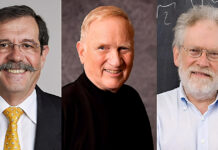
He keeps his eyes wide open as if with them he can catch all the mysteries of life. Cautious, he masters his shyness and, without protesting, he follows the photographer’s suggestions, at which point we ask him what his biggest hobby is. “Physics”, he answers without hesitation and, after a brief silence, adds: “my two daughters.” The photographer continues her work. Silence conquers the library of the Madrid School of Mining Engineers, where the interview takes place. But he doesn’t take long to break it down to clarify: “Greek mythology. Many of its characters have inspired great discoveries in quantum physics, such as the Sisyphus Effect and the Zeno Effect.” It is then when he relates that his father is a professor of Latin and Greek, and his mother, of Mathematics. He wanted to study Industrial Engineering, but when he discovered that what was interesting in this School was more the result of problems than the reason for its genesis, he decided to enroll in the Faculty of Physics of the Complutense University of Madrid. “Then I did three years of Engineering. I was aware that making a living from research was going to be almost impossible.” It has not been so.
–What exactly is a quantum computer?
-It is a machine that, unlike classical computers, uses the laws of quantum mechanics to solve problems. They are very rare laws that until very recently were used to create paradoxes and that have been attractive to the philosophy of science. But from the studies of Planck and Schrödinger, it began to be found that they could be applied to computing.
–What are these laws and why are they so rare?
-One of them says: “things are not defined, unless you observe them.” For example: the Moon is not in place until I observe it. Another law argues: “A cat can be alive and dead at the same time.” And a third, result of the union of the first law and the second, expresses that: “a cat ceases to be alive and dead at the same time when one observes it. At that moment it is either alive, or it is dead. But if it is not observed, its state is not defined. ” A fourth law states: “a particle can go through two holes at the same time, two holes that can be anywhere”. To test this fourth law, fullerenes – carbon molecules – whose structure is like a soccer ball were used. And it was proven to be true. It should be noted that these laws are only valid in quantum mechanics. That is to say, in the microscopic world, in the macroscopic world the imperfections are greater.
–With respect to this fourth law, does the atom go through two holes at the same time because it divides?
– That is the difficult thing to find out, because when it passes through the two holes at the same time its state is not defined. That is, you are not observing. But the moment you look at it, it can only pass one place at a time. This, which is so rare, happens and has given rise to many paradoxes and experiments. In the future it is hoped to be able to transmit information using this law and the other three that I have mentioned.
–Could you tell us three basic words for the elementary understanding of quantum physics?
-The first word would be: superposition or the possibility of having two different properties, and at the same time, in the same object. Something can be yellow and green at the same time in different or overlapping universes. Or what is the same, an atom can be in two places at the same time, in a state of superposition. The second word would be entanglement, for which two systems are needed and the state of those two systems must be an overlap. An example: you have two coins. Each coin can be heads, tails or in a state of superposition, that is, heads and tails at the same time or neither heads nor tails. If you have both coins on heads, you have an interlaced state. But by looking at one of these coins, she decides whether she wants to be heads or tails. The third word would be measure or observation because when you look at the object, it changes. By looking at it you modify it. When you look at it you always see it in heads or tails.
–You are one of the world’s leading specialists in entanglement theory. What does this theory consist of, and why is it necessary for the construction of a computer of qubits – quantum bits – and for the development of its cryptography?
-The entanglement only exists when we apply the laws that I have just pointed out to two objects. Never when applied to a single object. Why? Well, because these two objects are in a quantum state or what is also called a situation. Imagine that you have a laser beam that is emitting two entangled photons at a time. Each of these two photons goes, through fiber optics, in one direction. You are in the place where one of the photons remains, and I, with a detector, in the place where the other arrives. When the two photons reach their destinations, if I do something about my photon, the other will find out, although there is no link between them that we know of. On the other hand, nobody will be able to intervene in our communication because the photons would be immediately aware and would self-destruct. That is, their state of entanglement would be destroyed when observed. This tells us how pure these states are.
–So you could almost say that those two entangled photons communicate telepathically.
-Just as, in a certain sense, two people with an immense wall in between can communicate telepathically, the same happens with entangled photons that communicate, even though we do not know the link between them.
–Besides the crypto app, are there any more?
-The intention is to apply it to quantum computing, in order to obtain the highest efficiency, through the entangled states of various particles, in this case of atoms and photons. Currently, there are algorithms to solve computer problems. With them and with classical mechanics it took us some time to do the calculations. But if the laws of quantum mechanics are used to solve problems in algorithms, it would take much less time. A quantum computer will solve problems in a minute that today, with a classical one, would take millions of years to solve.
–Has Entanglement Theory already been used for any practical purpose?
-Today it is very useful in quantum cryptography. It is used successfully to send secret messages but only with a maximum distance of forty miles. And it has worked with the experiment that I have just related.
–What are the biggest difficulties in building a quantum computer?
-The use of the laws of quantum mechanics and the domain of the microscopic world, in which they are developed. It is a world that must be perfectly controlled in order to advance on this path. Today we are not able to dominate and control it. A quantum computer has been made of two very tiny atoms, some of three. But a computer with millions of atoms is required to be useful in computing. A classical computer is made up of bits, a quantum one is made up of quantum bits. An atom is a quantum bit, also called a qubit. For that computer to exist, we will have to wait a few years.
–So the announcement that IBM has made about the birth of the first qubit computer is not real?
-To have a quantum computer you need a large laboratory, and in it, a vacuum chamber in which today there are three, four or, at most, five atoms. In that laboratory there should also be lasers and many lenses, among other things. What I am trying to explain is that there is no qubit computer yet. The only thing IBM has created is a system with three or four atoms, at most five. In the computer that you have presented, there can be superpositions, but the states are not entangled, and entanglement is one of the properties necessary to create a quantum computer. What will they be like in the future? What shape will they have? Is very soon to know it.
–What else is needed to create a qubit computer?
-A quantum computer needs a large room, in which there must be a very localized vacuum chamber. It also requires lasers and many lenses; optics is essential in quantum computing because the laser has to be focused with many microscopic lenses. If we have all this and the technology necessary to create the vacuum in the chamber, the next step is to get three, four or five atoms to be in that vacuum chamber. If we succeed, which is very difficult, we will communicate with them through lasers. The laser, as if it were a mirror, will put the atoms face, cross or in a state of superposition. When you see the atoms, they are positioned to give you the result of the computation. When these atoms are ready to receive the laser, we must also be prepared to be able to change or position them in a different way, according to the needs of the operation. Think that an atom has infinite possibilities and that, consequently, the computational operations are also infinite. Today there are three quantum algorithms that are better than the classical ones. With them, operations are carried out that are impossible with classic computers, but more needs to be discovered. Computer scientists create these algorithms and we theoretical physicists study how to apply them to atoms and try to make them behave like a computer. Finally, mathematicians structure these theories with their language, something in which theoretical physicists also participate. With classical mechanics we put the number 5 in the computer and it gives us a result.Quantum mechanics would allow us to make the income declaration in a second, in fact we could do several in that time because many calculations can be undertaken at the same time with a single operation.
–What projects are competing today to create a quantum computer?
-Almost all of them are made with atoms. In one of them, a quantum computer made with trapped atoms and interacting with lasers is being developed. Another develops this computer with atoms in mirrors, which are also inside the vacuum chamber. The atoms look at each other and communicate by looking in the mirror or, what is the same, through the reflection or light that is absorbed by the other atom. A third project is made with electrons. In this case, they are solid systems that are not inside the vacuum chamber but are on a surface, cooling to temperatures close to absolute zero. Very stable currents are passed through them.
–What is the role that Spain can play in the development of quantum mechanics?
-Spain has some of the best faculties in the world to study physics. But quantum mechanics requires a large investment in technology and in training professionals, something that is not the case in Spain. I hope things go better since, at this moment, there are many scientists who, after doing their doctorates here, have gone abroad to specialize, and when they return they have not found work. The inbreeding that exists in the Spanish university is terrible and I am not optimistic about it. This problem also occurs in other universities in the world, but at a lower level.
–Quantum physics seems to be very close to the arts that cultivate the spirit. What is your relationship with music?
-Music is sound, sound is described with waves and in quantum mechanics everything can be described in terms of waves. Some of the properties that occur in sound also happen in quantum mechanics. Music is an art very close to this.
–And after the music?
– Literature, in particular Greek mythology. Some of the effects that have been discovered in quantum mechanics are based on mythological stories, such as Sisyphus, a character who is punished by the gods forcing him to carry a stone to the peak of a mountain. When he reaches the top, the stone falls from him and everything begins again. The Sisyphus Cooldown is a physical effect that occurs by cooling atoms, which rise and then start over from the beginning. The Zeno Effect is another consequence of the relationship between Greek mythology and quantum mechanics. Zeno said that nothing moves, and explained it with the example of an arrow. It said that when launched, it had to travel half the distance before reaching its target, and before it had to travel half the distance and so on. In quantum mechanics, if you look at an atom, you keep it in the face, when you stop looking at it, the atom begins to travel a path, like the arrow, to place itself in a cross, but you look at it again and place it in the face again. . We are trying to dominate this effect and also the opposite, that is, not looking at it so that it changes state.
–Why is it so difficult to understand how new technologies work, if they are an extension of our minds?
-They are an extension of our body, of our mind, but do we understand and understand our minds?
–What computer do you have at home?
-A something used with the Windows 95 program.
Juana Vera
This interview was published in December 2000, in number 235 of VERY Interesting.