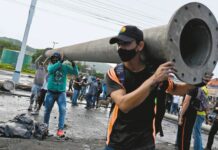
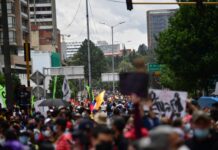
This writing wants to contribute to the understanding of the Colombian social outbreak while seeking to offer a renewed view of our current struggles, in the midst of bloody police repression.
Agúzate, they are watching you!
Get down, they are throwing you!
Richie ray y bobby cruz
A good time has passed since “a man from the town of Neguá, on the coast of Colombia, was able to ascend to high heaven.” It is well known what he told on his return. “He said that he had contemplated, from up there, human life. And he said that we are a sea of little fires. That is the world, ‘he revealed. A lot of people, a sea of fires ”(Galeano: 1989). That man, who must have been very young and reckless at the time, is at this hour giving reasons at a police station. It will not be easy, according to his custodians, to detach his incendiary premonition from the powder keg that Colombia has become since last Wednesday, April 28, 2021.
Since then and until Monday, May 10, there have been dozens of murders at the hands of the public force [Temblores ONG and INDEPAZ] and hundreds of disappeared [Ombudsman’s Office]. With them, the victims of sexual violence by agents of the Army and the Police [NGO Tremors], the eye injured in the protests [NGO Tremors] and the hundreds of cases of physical violence and torture against protesters [Ombudsman’s Office] they have claimed the attention of the world. Colombia is a sea of fires: a massive and spontaneous upheaval that shakes the foundations of its social and political system. This writing wants to contribute to the understanding of the Colombian social outbreak while seeking to offer a renewed view of our current struggles and serve as a link so that forces continue to be chained and rebel states of mind are sustained in the midst of bloody police repression.
Understanding the situation requires a historical look not to learn from the mistakes of the past but to identify what is unique in the present, in relation to the above, and refine strategies for action. Let’s think of contemporary Colombia as a machine room with three contiguous and chained artifacts. Three historical gadgets with different manufactures, with different beginnings and in unequal conditions of conservation and wear. Three historical temporalities that coexist and that mesh with each other.
The first artifact is the anti-subversive discourse: ideological support for the political project that has governed the country for almost the entire current century. The hatred of the FARC guerrillas – built in the media as the national enemy par excellence since the first presidential election of Álvaro Uribe Vélez (2002) – supported a state of opinion that practically suppressed any expression of dissent. The antiterrorist narrative absorbed national life, almost completely excluding public discussion about the economic and social project of the country that was making its way. The Uribe machine produced an insurmountable horizon of meaning. It offered national unity while filtering through civil society, clotting every citizen with the promise of being a participant in a common front against the public enemy. The frustrations of Colombian society and their discontent were channeled through anti-subversive hatred.
 Follow the news of El Espectador on Google News
The beginning of the peace negotiations began to disrupt the mechanism. Colombia has witnessed a gradual resurgence of social protest during the last decade. The disarmament of the Farc from the Havana Peace Accords (2016) cracked the binding force of the anti-subversive discourse. Even so, some reconfigurations of its motor principle, such as the fear of Chavismo, ensured a new electoral victory for Uribismo in 2018. The social mobilization of 2019, which was unleashed with force shortly after the Chilean outbreak, announced what the current upheaval has made it undeniable. The Uribe machine as a producer of meaning for the nation is inoperative. It does not have the capacity to offer futures to citizens; in particular to the youths. Its decomposition in turn sabotages the adjoining machine with which it was engaged from the beginning: state neoliberalism.
The success of the Uribista state of opinion and the criminalization of popular movements ensured the advance – without restrictions – of the neoliberal agenda in Colombia. The acute underfunding of public higher education, the interference of financial capital in the health system, the systematic sale of official assets, and deregulation and job insecurity have characterized the last 30 years of Colombian economic policy. Public finances depend on the exploitation of natural resources – whose cycles and oscillations have marked the pattern of economic growth – and on a regressive fiscal system that has not stopped deepening the country’s economic inequality.
Colombia has the highest regional development inequality in all of Latin America (Idere Latam: 2020) and one of the highest income concentration indices in the world (World Bank: 2011). A poor family must work for 12 generations to raise its socioeconomic status, according to the calculation of the Organization for Economic Cooperation and Development (OECD) in 2018, almost three times the average time needed by the other countries of the organization. The economic crisis of the pandemic has been dealt with with insufficient social policy. Additional public spending as a percentage of GDP, 4.1% (IMF: 2020), is well below the regional average, 8.5% (IDB: 2020), which, in turn, lags behind the average of the economies advanced, 18% (IDB: 2020). In a pandemic year, the country lost more than a decade of progress against poverty. The growth of monetary poverty in 2020 was 6.8 percentage points, reaching 42.5% of the population.
However, the socioeconomic crisis of Colombian neoliberalism only manifested itself massively as social protest in November 2019, when in most of the countries of the region it had produced leftist governments a decade earlier. The social outbreak of 2021 directed social discontent towards the economic policy of the government in power at the same moment that the anti-subversive machine of meaning finally exhausted its symbolic force. By the way, Uribe itself has wanted these days to reconstruct the public enemy in the form of a delirious molecular revolution of Deleuzian inspiration.
(You can also see: What are the reasons that feed the National Strike? )
In Colombia, the state of opinion allowed the deepening of the neoliberal agenda to avoid popular resistance. Even so, the neoliberal device of domination that has ensured its global success did not cease to operate: the neoliberal form of subjectivity. Uribe’s state of opinion was only his local vehicle on the state stage. The States, however, have become proconsular actors of an anonymous empire (Villacañas: 2020). Lately, a part of the western left has drawn attention to the urgency of criticizing the current ways of desiring , relating and being subjects. The horizon of meaning that constitutes the neoliberal subject – the symbolic delimitation of what is visible and thinkable for him – is the third machine that enters the scene in this diagnosis.
The attack on the official economic policy, which broke out with the decomposition of the Uribe machine , opens a war front against state neoliberalism. What we cannot do is celebrate civil society as an immediate place of emancipation. The new emergence of the collective –especially after the social distancing of the pandemic– is only a first step that paves the way for dismantling the atomistic constitution of the neoliberal subject. There are no kill-bill blows to capitalism with deepening crisis (Žižek: 2020). At least not immediately. Cristhian Laval recalls, regarding Foucault’s criticism of the biopolitical government, “that civil society, reduced to the sphere of economic competition, is now the preferred place to establish neoliberal governmentality” (Villacañas: 2020).
The greatest utopia of capitalist governance is realized in the current neoliberal subject. Imagine a financial capitalism whose crises do not provoke class consciousness (Villacañas: 2020). Let’s say more. A social state whose growing structural disruptions can only be narrated by subjects – informal, precarious, unemployed – in the form of cruel self-criticism, heavy responsibilities and a permanent distrust of their own worth. The utopia of classical liberalism was that of a political order that would solve the problems of the institution and regulation of the social by only respecting the natural force of the market and private interests; thus avoiding the complicated treatises of political philosophy. Neoliberalism is not the duty of a political system, it even goes through the egalitarian democratic imaginary to deal with the direct government of subjectivities.
In this regard, the pandemic showed the explosion of a very particular form of concern about oneself: the need to “cheat” –physically and intellectually– to become more digestible in the social, love and work world. It is not this return to interiority that we claim should support the work of the emerging citizenship that takes to the streets of Colombia. Social mobilization is in a position to deliver a final blow to the Uribe machine and the anti-neoliberal public agenda is the entry way for the initial encounter between atomized subjects emerging from “social distancing”. Still, this is not the death of neoliberalism. An additional element of the neoliberal subject, in addition to his inability to work out his frustrations without undermining his own confidence, can still lend him oxygen.
(It may be of your interest: Racism, poverty and hunger: the social bomb of Cali in the National Strike )
The subject, in its current historical constitution, is not a space for emancipation. It is about breaking with historical time with the sole desire not to be governed in the way that we currently are (Foucault: 1984). No other justification is required.
The semantic trajectory of two relevant concepts in the contemporary political universe helps to clarify the limits of neoliberal subjectivity: its servility. Let us first consider the intensification of the sense of freedom . Neoliberalism decrees the maximum experience of freedom. Liberty? All you want, it is enough that it is channeled through the market! (Villacañas: 2020). The compensation of a way of life that in its daily life seems to make no one fall in love takes place exclusively through the final redemption in consumption. The freedom to choose that neoclassical economics speaks of, and all the denunciations of lack of freedom that are wielded in the face of any restriction in the enjoyment of consumer goods and services, show that the concept of freedom is increasingly located within of the horizon of market sense. The concept of totalitarianism that currently includes almost any affectation of the sovereign autonomy of the economic sphere also accounts for this journey. The “libertarian” responses to sanitary restrictions bear witness to the phenomenon. In short, the hedonistic exercise of freedom ensures neoliberal governmentality. This individualist hedonism has a reverse side that allows us to understand the second great challenge facing Colombian social protest in the face of the current barrage of state repression. The first is of course to survive.
The society of hedonism is on the other hand a palliative society. “Today there is everywhere an algophobia or a phobia of pain, a general fear of suffering” (Byung-Chul Han: 2021). The best that can be aspired in relation to pain is to render it as quickly as possible, as soon as it occurs. The consumer reward of our way of life urgently demands it. The disastrous consequence is translated into the impossibility of the processes of artistic and intellectual creation. Passion, agony and tragic feeling as creative laboratories need the narrative elaboration of pain, not its analgesic suppression. In its absence the mediocrity of mass art flourishes. We can live without passion and without owners, here is the great freedom that this society offers us (Anonymous: 1988). The ferocity of repression requires dusting off all our cultural tools to narrate the pain and deal with it together. This is the second encounter – and the recognition – between intimacies that must happen to the initial encounter of the citizenship that has taken to the streets. This is the return of the thread that goes from the collective to incubate a new intimacy that – unlike its neoliberal modus – breaks the atomization to the extent that it narrates and expresses the collective mourning.
Boaventura de Sousa Santos has said about the Colombian social outbreak that “neoliberalism does not die without killing, but the more it kills, the more it dies” (De Sousa: 2021). This seems more valid to speak of the Uribista political regime that is dying in criminal despair. Neoliberalism, for its part, can survive with the deaths that the Colombian State is managing, precisely if the scarcity of cultural tools prevails to deal with pain and to build and support – with and through it – units of political action that sustain the rebellious mood. The national strike may die of desolation.
(It may interest you: Social protest and the future of Colombia according to Boaventura de Sousa Santos )
Faced with this scenario, it is in no way a matter of complying with the champions of mindfulness who sit in full-time from their moral Instagram windows. “Positive psychology even subjects pain to a logic of performance. Resilience training as an exercise of psychological strength has the function of converting man into a subject capable of performance, insensitive to pain as far as possible and continually happy ”(Byung-Chul Han: 2021). Efficient and individualistic pain treatment impairs their ability to be narrated . The elevation of frivolity as a supreme value and the celebration of the self-absorbed silence of the duel can be seen in the following messages from the Colombian collective Paz mi pez , which give an account of one of the abysses of meaning through which it is wanted to unravel – in addition to the use systemic of explicit violence – the rebellious cry of this sea of fires. The critique of the dominant subjectivity enables us to face these sensitivities that quench rebellion with the analgesic effect of servility that characterizes neoliberal inner life.
“It will not take a wounded cry,
not a dagger, not a stinger.
It won’t take a whimper
not a pinch, not a burn
(Your example would suffice:
would be left over with his action) “.
“So…
The only revolution
it’s its own evolution
(Believe it or not).
“As long as there is
rage in you,
the flag
it will continue the other way around ”.
“From those who rejoice in the spaces that they manage to cut out – and to safeguard for themselves in this society – the very way of palpating existence separates us, even before reflection. We understand that our life, our desires, are the authentic place of social warfare ”.
( Anonymous: 1988).
To the operation of the three machines with which we wanted to shed light on contemporary Colombia, we can oppose the image of a fabric in counterpoint that goes from the ongoing popular struggles to the nascent community spaces of mourning and creation, to return from there to the definition of new experiences and practices of the common . We do not take the side of the individual to confront the State, we seek new forms of subjectivation that take advantage of the meeting spaces open to the social outbreak. The urgency of the present is to confront both the dominant economic policy and the atomization and frivolity of the neoliberal subject that has positioned itself as the horizon of privileged meaning of our contemporaneity.
Bibliography
Anonymous. (1989). Ai ferry corti. Breaking With This Reality: Its Defenders and Its False Critics. Retrieved May 7, 2021 from: https://vivalaanarquia.files.wordpress.com/2011/01/ai-ferri-corti.pdf
From Sousa Santos, Boaventura. (2021). Colombia on fire: The end of neoliberalism will be violent . Retrieved on May 9, 2021 from: https://ilsa.org.co/colombia-en-llamas-el-fin-del-neoliberalismo-sera-violento/
Foucault, Michel. (1984). What is criticism? Criticism and Aufklärung ” . Revista de Filosofía-ULA 11 (1995): 5–25.
Galeano, Eduardo. (1989). A sea of little fires . In: The book of hugs . Twenty-first Century Publishers. Retrieved May 8, 2021 from: http://formacion.intef.es/pluginfile.php/246851/mod_resource/content/2/Archivo%20zip/un_mar_de_fueguitos.html
Han, Byung-Chul. (2021). The palliative society . Barcelona: Editorial Herder.
Villacañas, José Luis. (2020). Neoliberalism as Political Theology: Habermas, Foucault, Dardot, Laval, and the History of Contemporary Capitalism . (E-pub).
Žižek, Slavoj. (2020). A ‘Kill Bill’ hit to capitalism. Retrieved May 10, 2021 from: https://ctxt.es/es/20200302/Firmas/31443/Slavoj-Zizek-coronavirus-virus-sistema-Orban-comunismo-liberalismo.htm
* Economist and historian. Master’s student in Economic Sciences. Researcher at the Pluralize Peace Thought Center of the National University of Colombia.