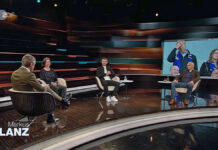
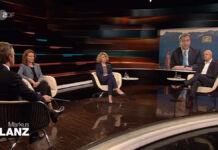
At Markus Lanz (ZDF) there is an emotional discussion about the question of whether one can still say everything at all. There are no clear answers.
It is a bit ironic to discuss the question of whether one can still say everything in one of the many, many talk shows that flicker across the screens almost every day. Markus Lanz talked about this with his guests on ZDF and immediately confronted Giovanni di Lorenzo, publicist and editor of “Zeit” with a recent survey, according to which 44% of Germans believe that you can no longer say everything. He said that there is, as a matter of principle, complete freedom of expression in the Federal Republic of Germany, so the survey rather suggests that many people are worried about the reaction that may follow an opinion expressed.
The political scientist Emilia Roig, author of the bestseller “Why We Matter”, pointed out a paradigm shift in Markus Lanz on ZDF, which thankfully many racist or sexist remarks, which are often unconsciously expressed, are no longer tolerated.
Markus Lanz (ZDF): Certain statements are made to the whole world
In principle, the author Thea Dorn at Markus Lanz (ZDF) agreed with her, but asks how far the control of the language should go. If, even in ancient texts, terms that are of course no longer used today are changed so as not to harm one’s well-being, the measure is full.
Sascha Lobo, blogger and columnist, pointed out the peculiarities of the culture of controversy on the Internet at Markus Lanz on ZDF: “Due to the Internet, you can hardly say anything today without getting an answer.” On the one hand, the Internet makes more and more people possible to express oneself, including those from groups that were barely heard before. On the other hand, publicly expressing previously private opinions also means that certain statements are no longer made in small groups, perhaps at the regulars’ table, but rather in front of the whole world.
Markus Lanz on ZDF: Increasing loss of the culture of discussion
In this regard, Di Lorenzo pointed out to Markus Lanz on ZDF that there was an increasing loss of discussion culture. More and more often people are not only criticized, but downright ostracized, because of questionable, but only punctual, statements.
Thea Dorn also asked Markus Lanz (ZDF) whether the revolution was already eating its children, whether allegations against the Turkish-born Berlin theater director Shermin Langhoff, who was accused of bullying, follow a culture that has become hyper-sensitive: “Aggressive mimosity from the right, cannot be fought by aggressive mimosity from the left. “
| Guests | job |
| Giovanni di Lorenzo | publicist |
| Emilia Roig | Political scientist |
| Thea Dorn | Author |
| Sasha Lobo | Blogger |
These are extreme situations, however, Sasha Lobo said at Markus Lanz on ZDF, who believes in the healing power of even violent allegations. The case of Jens Lehmann was cited as a good example by Lobo, who after a racist remark that had become public, lost various sponsorship contracts, but was almost pushed into a learning process.
Markus Lanz (ZDF): In the end there are no clear answers
Inevitably, the discussion with Markus Lanz on ZDF was on the topic of cancel culture, di Lorenzo mentioned an interview for Zeit magazine that concerns about comments on cancel culture and identity politics inevitably led to severe criticism. On the other hand, the Woody Allen case, whose autobiography was not published by the original publisher, at least in America after violent protests. These are different things, said Lobo, that are essential to differentiate. In one case there are specific allegations in the room, in the other it is about possible criticism of statements. Lobo did not want to deny that in some cases the consequences of the cancel culture degenerate and have problematic consequences, but he suspects that these excesses are temporary labor pains.
But how do you deal with conspiracy theorists? With people who no longer seem available for rational arguments? Have patience? Stay calm? There were no clear answers at the end of the exciting debate with Markus Lanz on ZDF, the topic will not only be discussed in German society for a long time – and will certainly soon also be in another panel discussion. (Michael Meyns)