The question is not easy to answer. First, it is necessary to define what we mean by “pain” , and we are going to refer to physical pain, the one that one feels when one is hit or injured. Just as we, vertebrate mammals and primates, suffer, pain can be reduced to a warning signal that our nervous system sends us to indicate that something is not working well. Depending on the type of damage suffered, the pain responds differently, generating different sensations that can range from a punctual puncture to sustained pressure over time.
sensing the pain
Our body has a large number of nerve receptors, adapted to perceive different forms of stimuli; photoceptors that detect light in the retina of our eyes; chemoceptors that detect chemical stimuli lining our tongue or the inner surface of the nasal pituitaries; mechanoceptors that detect pressure changes both in the skin and in the inner ear; thermoceptors that detect thermal stimuli such as heat or cold; proprioceptors that tell the brain where each part of the body is at all times —thanks to them you can touch the tip of your nose with your eyes closed— and we also have nociceptors. These are the nerve receptors responsible for transforming the aggressive stimulus into a nerve signal that the brain recognizes as pain. So, from the anthropocentric point of view, you can suffer pain if you have nociceptors.
It is important to note that nociception is the detection of something that is causing you harm , and is responsible for its consequent reflection. But it does not imply that there is a feeling or a sensation attached to it. An animal can suffer pain without having a cognition system that recognizes that suffering. In other words, when we talk about nociception we talk about that purely physiological aspect of perception of damage, not the subjective and emotional system associated with that pain.
We know that we suffer from it, from personal experience, and we are quite clear that a few animals close to us in evolutionary terms also suffer from it, such as other primates, cetaceans, dogs, rats and even crows. But beyond that, knowing if that emotional response exists or not is very difficult to verify. So we will focus on the purely physiological aspect of pain.
Nociception without nociceptors
To the best of our knowledge, insects do not have nociceptors . At least they haven’t been found. So, in principle, it could be said that insects do not feel pain. At least not as we feel it, not as we have defined pain.
But not so fast. Yes, insects have been found that have a behavior consistent with suffering from pain . There are insects that show nociception, but without nociceptors. So much so, that in the fruit fly ( Drosophila melanogaster ), the most widely used insect in the laboratory and probably the most and best studied of all, we have mutant strains called painless. That is, mutants whose characteristic feature is their inability to feel pain. So, by extension, we must assume that the rest are capable of feeling it.
This has an explanation. Although these insects do not have the same specific receptors that we do, they do have neurons that extend their ramifications through the animal’s skin, in a similar way to our nociceptors. This analogy is produced to such an extent that a study in 2019 led by Thang Khuong, from the University of Sydney, was able to verify that the fruit fly was capable of suffering chronic pain .
If we restrict the definition of “pain” in an anthropocentric way, it is evident that insects do not feel that. However, we know that they have the same type of responses to these harmful stimuli, and in the case of flies, this response is given by a system analogous to our nociceptors. They feel, therefore, a form of pain , understanding the word in a broad sense, which is analogous to what we perceive as pain.
the community pain
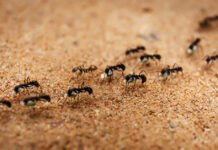
In insects that have a social organization, such as ants, it is common for individuals in the colony to communicate with each other by exchanging chemicals called pheromones. Among the multiple types of pheromones that exist, there are some particular ones that myrmecologists —scientists who study ants— call alarm pheromones , composed of extraordinarily volatile substances that disperse quickly, so that when an ant emits one of these alarms, all his close congeners receive it.
These alarm pheromones are emitted by the ants when they perceive some danger , and more particularly, when they suffer aggression, a stimulus that for us would be considered painful. Of course, nearby ants receive the alarm pheromone, and respond to it by emitting more alarm pheromones. Depending on the type of ant that receives it, it will react differently, either aggressively, sending rescue missions to the injured ant, or going to protect the offspring of the anthill. It is a kind of communication of pain, with a clearly favored social cohesion effect at the evolutionary level.
These pheromones are producing a form analogous to the nerve pain that we feel , or even flies; a chemical pain that, unlike ours, is communicated to its close sisters and induces in them that reaction of defense, rescue or protection. A warning signal that their body sends to them and to those around them, to indicate that something is not working well. Something that we do not understand how it should feel, because we do not have the ability to feel it, in the same way that they, the ants, do not have the ability to feel the pain transmitted by nociceptors that we feel.
REFERENCES:
Adamo, S. A. 2016. Do insects feel pain? A question at the intersection of animal behaviour, philosophy and robotics. Animal Behaviour, 118, 75-79. DOI: 10.1016/j.anbehav.2016.05.005
Frank, E. T., Schmitt, T., et al. 2017. Saving the injured: Rescue behavior in the termite-hunting ant Megaponera analis. Science Advances, 3(4), e1602187. DOI: 10.1126/sciadv.1602187
Khuong, T. M., Wang, Q.-P., et al. 2019. Nerve injury drives a heightened state of vigilance and neuropathic sensitization in Drosophila. Science Advances, 5(7), eaaw4099. DOI: 10.1126/sciadv.aaw4099
Tracey, W. D., Wilson, R. I., et al. 2003. painless, a Drosophila Gene Essential for Nociception. Cell, 113(2), 261-273. DOI: 10.1016/S0092-8674(03)00272-1
Vidal Cordero, JM 2021. The ants. CSIC, Cataract.