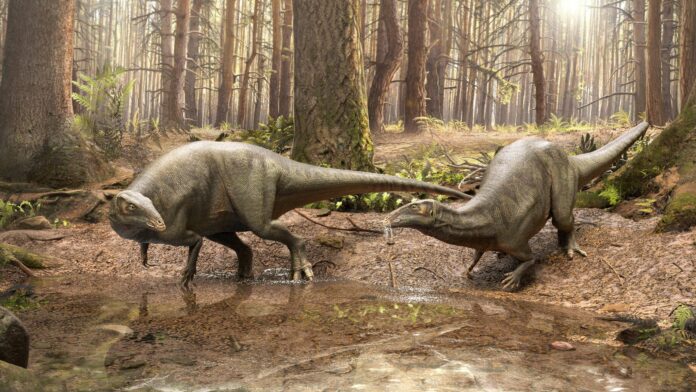
In 1991 a few fossil remains were found in Portugal. The dinosaur to which they belonged was not scientifically described until 2001. There are hardly any reconstructions of this specimen and doubts are outweighing the certainties that researchers can affirm about this species. Following new fossil materials, a recent study has changed the point of view regarding the classification of this dinosaur.
A “small” and bipedal herbivore
Draconyx loureroi was a small, slender, bipedal herbivorous dinosaur . This is how the experts imagine it who, after analyzing the anatomy of the animal’s forelimbs and hindlimbs, defend that it was an agile species, capable of using its hands to grab its food. This is an ability that surprises scholars, since the closest relatives of Draconyx loureroi are large animals that walked on four legs, which means that the structure of the front legs was significantly modified.
In 2010, Gregory S. Paul estimated the length of this species at 3.5 meters, and can reach a weight of up to 150 kilos . Given that other nearby herbivores measured 10 meters in length and weighed an average of 3 tons, we have a context by which, despite its measurements, we can qualify D. loureroi as a “small” herbivore.
It lived at the end of the Jurassic period, around 150 million years ago , during the Tithonian age, in present-day Europe. Its name means “João Loureiro’s Dragon’s Claw” , in homage to an 18th century Jesuit priest, a pioneer in Portuguese paleontology who also worked on astronomy, botany and medicine.
Reassessment and classification
It is the first ornithopod dinosaur described in Portugal . Ornithopods were dinosaurs endowed with three-toed legs, just like birds. They were herbivores that prospered successfully, especially in North America, thanks to one of the most highly developed chewing apparatus in reptile history. Draconix loureroi , in particular, is classified in the iguanodontid family, dinosaurs that lived from the lower to the upper Cretaceous, between 140 and 100 million years ago. Of this family, the species Iguanodon bernissartensis stands out, whose skeleton was one of the first dinosaur fossils exposed to the public , assembled in 1882 in the palace of Carlos de Lorraine, in Brussels.
It was originally related to camptosaurids, but a recent study argues that:
“Draconyx loureiroi is a valid taxon nested in Styracosterna (Styracoterns) and is clearly diagnosable by a unique combination of characters.”
The fossil remains were discovered in 1991 by Carlos Anunciaçao in an expedition carried out in Vale de Frades, in Lourinhã , located about 70 kilometers north of Lisbon. However, the scientific description of the find did not take place until 2001 , when Octávio Mateus and Miguel Telles Antunes published the study in the journal “Annales de Paléontologie”. It was in this work that it was classified as a new camptosaurus.
Twenty years later, the original discoverer, Carlos Anunciaçao, has donated additional fossil material to the Lourinhã Museum to those already studied. Specifically, the bones correspond to the hand of Draconyx loureiro . These remains have provided the opportunity to reassess the species thanks to the new information obtained, the results of which have been published in the “Zoological Journal of the Linnean Society” in February 2022. Filippo Maria Rotatori headed the research team in charge of the new study , who thinks that:
“It is probably the most complete hand of this type of animal for the Jurassic in Europe. When I first saw the material, I immediately understood that we needed to take a closer look at the Draconyx specimen, which had not been studied for 20 years. The results of our research indicate that we still have a lot to discover regarding these animals, and we are just beginning to realize their diversity here in Portugal.”
The holotype of Draconyx loureroi can be visited in Dinoparque de Lourinhã, a municipality famous for the discovery of Upper Jurassic dinosaurs that has more than thirty years of paleontological activity visible, for the most part, in the Lourinhã Museum itself. That is why this geological formation attracts scientists from all over the world, who will continue unearthing knowledge like those yet to come about Draconyx loureroi .
References:
Mateus, O. and Telles Antunes, M. 2001. Draconyx loureiroi, a new camptosauridae (Dinosauria, Ornithopoda) from the Late Jurassic of Lourinhã, PortugalDraconyx loureiroi, a nouveau camptosauridae (Dinosauria, Ornithopoda) du Jurassique supérieur de Lourinhã, Portugal. Annales de Paleontologie 87, 1, 61-73. DOI: 10.1016/S0753-3969(01)88003-4.
Rotatori, F. M. et al. 2022. Reappraisal and new material of the holotype of Draconyx loureiroi (Ornithischia: Iguanodontia) provide insights on the tempo and modo of evolution of thumb-spiked dinosaurs. Zoological Journal of the Linnean Society 195, 1, 125-156. DOI: 10.1093/zoolinnean/zlab113.
- Aragosaurus participates in a study on Draconyx, one of the earliest styracosternae. aragosaurus.com.
Cover image: Victor Carvalho CC BY NC 4.0.