The author of this text discusses the need to rethink the role of economists in the midst of the current situation in the country, since, she argues, economic policy has a social content and, in turn, social policy has serious implications on macroeconomic variables.
For several decades, Colombian economists, especially those trained at the Universidad de los Andes, were vaccinated against politics. The important thing was to belong to the new technocracy, that category of professionals full of brilliance, in whose hands would be the management of those macroeconomic balances essential for the development of the country. The National Planning Department, the Ministry of Finance and the Bank of the Republic were the obvious professional path, and incidentally one or another passed through the World Bank, the Monetary Fund and if not, the Inter-American Development Bank. With a certain degree of reason, politicians were regarded with some contempt, whose parties fought more to divide up the bureaucracy than to interpret the different ideological tendencies of society.
His contribution to what had been recognized as a careful management of the Colombian economy is undeniable. His abundant production of papers , full of quotes from gringo authors and the occasional Colombian or Latin American colleague, contributed to the planning of national development, to diagnoses on the reality of the country’s growth, to a healthy handling of monetary policy, although less to that fiscal policy that the country has always demanded. However, they left inequality on standby .
Also read: Colombia lost investment grade on the Standard & Poor’s scale
One of the milestones of that technocracy was the adoption in the country of the Washington Consensus as the new development model, called the Opening in 1990. César Gaviria, a graduate of the Andes School of Economics and who as president made the change of model, he was the only one who did not opt for technocracy but for politics.
From that moment, easily three decades ago, those orthodox ideas to analyze and guide the economy acquired such a dimension that, first, those who were considered old-fashioned for not sharing their principles (a lot of market and little state) ), and second, they achieved such primacy that today this group of professionals identify themselves as “the economists” of the country, excluding those who do not agree with the principles of neoliberalism. Especially in the last two decades, it is difficult to reach high positions such as the Ministry of Finance or the management of the Banco de la República if one is not part of “the economists.”
Criticism of this economic policy had started in the world some time ago, mainly due to its inability to distribute equitably the benefits and costs of developing countries. Piketty, Stiglitz and Krugman have been identified as the triumvirate against current capitalism, precisely because of the immense concentration of wealth it has generated in the world. But that debate has not taken place in Colombia, but on the contrary, its followers show off the reduction in poverty that had occurred up to a year before the pandemic hit and the positive growth, although lower than the historical one.
 Follow the news of El Espectador on Google News
But COVID-19 totally uncovers the inequalities, the huge social gaps that had been underestimated for decades. The answer of “the economists” is that the economic model is not touched, but the immense social cost is recognized and for this a New Social Contract is proposed. Its essence, cash transfers for the sectors most affected by the pandemic that include 42% of the poor, but say nothing of the 30% of vulnerable. In addition, it continues to be ignored that many of the problems have to do with the productive structure of this country and with the underestimation of the issues that affect people’s lives and that are considered subordinate to macroeconomic balances.
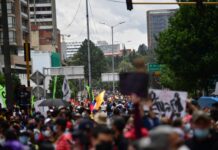
And there comes the social explosion that the pandemic had frozen, but that already in September had shown its effervescence because the expected results that were proposed to the Government and society in the 2019 mobilizations were never achieved. the people, the government’s insistence on its tax reform ignites this social outbreak. At this time, “economists” defend this reform and in a letter signed by 30 of them, they publicly support it one day before President Duque withdrew it and the worst social outbreak that the country has experienced in its recent history begins. .
Undoubtedly, they were convinced of the urgency of having resources that would prevent a negative reaction from risk rating agencies that would make credit for the country more expensive, precisely at this time. That may be true, but they omitted nothing less than the political reality, what the people were feeling and their possible reaction when the figures of the social crisis were already in view of all.
Also read: What can past tax reforms teach us?
His failure, not to consider as a fundamental part of his analytical context what happens to people. And with the best intention, without a doubt, they left the entire profession in a very bad way, including those of us who are not part of the so-called “economists.”
A very painful lesson that requires humility, less sobriety, because the life of society is much more than maintaining the balances of macro variables. Will dialogue with the other economists enter your agenda? But, in addition, will political economy enter the agenda again? Hopefully this reflection is not interpreted as an attack on those who feel alluded to. Let’s calm down and unite and without prejudice, let’s analyze what we are experiencing and our role as economists.
Without the slightest doubt, Colombia needs us all because these youth who cry out to be heard cannot be left with the idea that the answer to their requirements is the abuses of the Public Force, the disqualification of their actions and the lack of solidarity of us economists. The management of economic variables is critical at this time and the social repercussions cannot be marginal in the analyzes of the moment. It is worth remembering that economic policy has a social content and, in turn, social policy has serious implications for macroeconomic variables. Welcome the debate.