In 2016, the film ‘Hidden Figures’ by Theodore Melfi made known to the general public the lives of three African-American scientists who made great contributions to space exploration, at a time (1960s) and a place (the southern United States). United) in which women of color did not find it easy to stand out in an area reserved for white men.
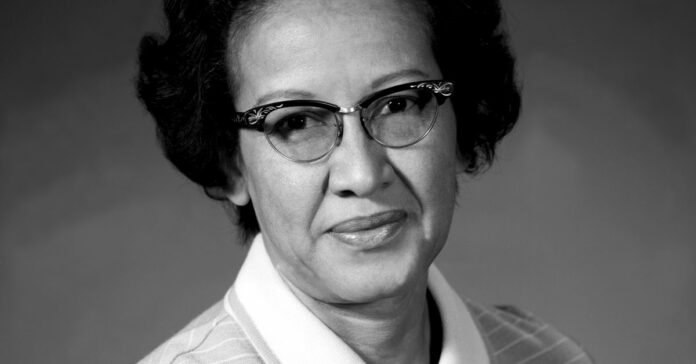
Katherine Johnson (1918-2020) was one of those hidden figures. Interestingly, Johnson was born on August 26, which currently coincides with the celebration of Women’s Equality Day in the US, in honor of the date on which the female vote was recognized in this country, in 1920. , Johnson never considered herself different. “I didn’t have time for that,” he once explained in an interview. “My father taught us that we were as good as anyone else in town, but that we were no better. I do not have and never have had a feeling of inferiority, I never did. I’m as good as anyone, but I’m no better ”, explained this extraordinary woman who has been a lover of calculus and mathematics since she could remember.
Although she began dedicating herself to teaching, the true professional path of Katherine Johnson was waiting in the National Advisory Committee of Aeronautics (NACA), a federal agency that would be the germ of the present NASA . Every year the Langley Research Center in Hampton, Virginia, hired African-American women to work as calculators, and during the 1950s many female scientists verified, from the shadows, the calculations that the agency’s engineers needed when the space race was in full swing. Johnson landed at the Langley Research Center in the summer of 1953, in a special area for people of color, with separate bathrooms and dining rooms.
Unknown territory
Katherine Johnson always expressed how lucky she was to be a pioneer and to experience firsthand the beginnings of a new adventure, a totally unknown territory. “We had to write our own textbook, there was nothing written about space, ” he once commented in an interview. “We had to turn to geometry and solve the problems from scratch. We were at the beginning, and I was one of those lucky people who were able to experience it up close ”.
Johnson’s work was essential for the flight of astronaut Alan Shepard, the first American sent into space and the second worldwide, after Yuri Gagarin, in 1961. Katherine Johnson was, of course, responsible for calculating the trajectory by Shepard . “The initial trajectory was a parabola, and it was very easy to predict where the capsule would be at any given moment,” said the scientist. “The problem was getting it to land in a certain place, and for that it was essential to calculate the exact time to take off. It’s what I told them: ‘Let me do it. Tell me when and where you want the capsule to land, and I will tell you when to take off, ‘”the brilliant mathematics recalled.
And the computers arrived
Now it seems a lie, but the first space flights were made, as someone say, ‘bareback’, with all the necessary calculations written in pencil and paper. The computer age was beginning, and computers were huge and monstrous machines that occupied entire rooms, with an extremely complex operation and whose operation required a high specialization.
Astronauts and engineers themselves had little confidence in these devices that could make calculations much more complicated and faster than the human mind. One of the most remembered anecdotes in the life of Katerine Johnson refers to the moment in which astronaut John Glenn, the third American to travel to space, stated that he would not fly until “the girl reviewed all the calculations of the trajectory.”
The ‘human calculator’ also began to use computers for their calculations, and continued to work at NASA until 1986, at which point he retired after 33 years of service. Behind him, the merit of having contributed decisively to the first milestones in the history of space exploration, including the calculation of the trajectory of Apollo 11 on its way to the Moon in 1969.
Katherine Johnson received numerous recognitions in her lifetime: at the age of 97 she received the Presidential Medal of Freedom from former President Barack Obama, and in 2017 NASA named one of its buildings the Katherine G. Johnson Computational Research Center . In addition to remaining linked to the US agency until the end of her days, the scientist was also very involved in the education and promotion of scientific vocations and STEM (science, technology, engineering and mathematics) careers among girls and young people. Her extraordinary career and the challenges she had to overcome as a woman and an African American are undoubtedly inspiring.
Johnson passed away on the morning of February 24, 2020 at the age of 101. NASA remembered this brilliant figure with an emotional tweet: “Tonight, we count the stars and we remember a pioneer. A no longer hidden figure, Katherine Johnson helped usher us into a new era in space exploration, and for that we are forever grateful. Please join us in reflecting on his powerful legacy. ”