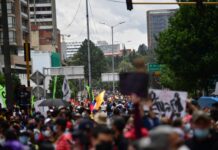
The dialectic of the master and the slave takes effect in the Colombian conjuncture. From this point of view, it is the excluded and subordinate people who can become self-aware and transform, through protest and their plans for the future, the relations of domination.
In the 1807 phenomenology of the spirit , the German philosopher GWF Hegel raised the famous dialectic of the “independence and subjection of self-consciousness; lordship and servitude ”, better known as the dialectic of master and slave. In a somewhat scholarly understanding of dialectics, the thesis would be lordship, the power that governs, the hegemonic power. The antithesis would be the slave or the servant subjected to servitude. And the synthesis would be embodied in the new reality, where the lord realizes his dependence on the servant and the servant that his being is reaffirmed by the lord. This is so because the lord, the master, cannot reproduce his life without the work of his slave, even if it is difficult for him to recognize that his life itself depends on the work of a being that he considers inferior, that is, almost as a non-being. ; and the servant has nothing to lose by ceasing to support another. His highest prize is the desired freedom.
It may interest you: Faced with loneliness and the disconnection of the human being, literature
When this happens, the lord comes to appear as the “inessential” and the servant as the essential. This awareness of the servant, or what Marx calls self-consciousness, is what allows him to realize the subjection and, therefore, to initiate through collective praxis his path to free himself from his oppressor.
This same dialectic was perceived by Humboldlt, in his exploration in New Granada, when he described the journey of the Spanish dominator from the Coast to the interior of the country, where the Indian brings the Lord on his back. When all the companions die, the Indian realizes (self-awareness) that his master’s life depends on his work, his expertise, and knowledge of the terrain, as shown by Professor Fabián Acosta in his book The Universe of Politics . Well, in Marx’s thought, this is equivalent to the self-consciousness of the proletariat about the way its work is the condition of possibility for the survival and reproduction of the bourgeois, capitalist system. In such a way that if the workers reveal themselves and make the revolution they end, not only with their miserable situation, but with the privileges of the capitalist or the owners of the means of production. The proletarian has nothing to lose with his revolutionary and subversive act, while the bourgeois loses everything, even his comfortable material living conditions. The result is the production of the new in historical praxis; is to make your history. It is an autopoietic act. For this reason, the fight to the death, in Hegel’s language, which arises in this dialectical relationship, can be resolved in an “overcoming”, the common-ism. In this relationship itself, the correlate of domination and subjection undergoes a metamorphosis, which is nothing more than a going beyond the established and hegemonic forms. From the dominance of some over others, one passes to synthesis, that is, to a new way of life where individuals have a rational control of the way they reproduce their own existence.
 Follow the news of El Espectador on Google News
Marx does not intend, then, to invert, to turn around the relations of domination, so that the worker dominates the bourgeois, since that maintains domination, but rather seeks to transform that relationship of power (to say it with the reviled Foucault). And what it is about, then, is to end the oppression of one another and create a new, unprecedented reality, as genuine feminism claims when it fights against patriarchy, since feminism does not seek to subdue man, but rather change relationships, the ways they coexist, how they relate, how they share social space.
We suggest: An amount of hope
If Theodor Adorno drew in his book Slogans a line between Kantian antagonism, the dialectic of Hegelian master and slave, and if this same antagonism can be applied to the struggle between the rulers (bourgeoisie, owners of the means of production, communication, and current political and economic monopolies) and the proletariat, it is clear, for me, that the same contradiction can be established between the economic and political power of the Colombian oligarchies (where politics is a family club, as Julio Sánchez Cristo says) and the thousands of unprotected and subalternized social sectors marching in Colombia at this time. In other words, the dialectic of the master and the slave takes effect in the retranslated Colombian conjuncture as the opposition between the oligarchic power, the stately republic, and the overcrowded and miserable and poor people. From this point of view, it is this excluded and subordinate people, the same people who march in the streets, who can become self-aware and transform those relations of domination through protest and their plans for the future. In this way, one could think, for example, of a constitution that, maintaining the spirit of that of 1991, preserves its political philosophy of the social rule of law and is committed to a constitutional reengineering, where the prosecutor is not appointed by the president, the the attorney general’s office is not elected by the senate, the ombudsman by the chamber of representatives; and that, rather, update their human dignity with an education, material conditions of existence, health, social security, worthy of a new political system.
From Hegel’s point of view, “overcome” and materialized by the praxis of Marx, which substitutes his speculative dialectic, the Colombian people, as a servant, must begin a path and a project of eliminating their servitude, giving rise to a system policy that guarantees a real and effective enjoyment of fundamental, economic, social and collective rights, in their entirety.
People must be made aware that the legitimacy and authority of power is derived, that all powers are derived, its servants, and not drones who live at its cost, its death and its work. In this sense, the sovereign people take charge of the social totality and their own destiny. The objective is to reconcile social justice, freedom and the potentialities of human multidimensionality. If this does not happen, we will continue as we are: a paper democracy that simulates modernity in the midst of a subservient and subjugated people.