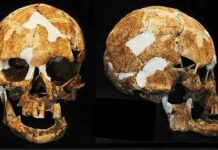
About us? Where we come from? Where we go? Since ancient times, humanity has sought answers to these great questions, and one way to approach their answers is the study of prehistory and our ancestors. Since Darwin’s theory of natural selection and the fact that species are not immutable, many scholars and adventurers have endeavored to search for our ancestors, to reconstruct the chronology of the human species, to find to that ‘missing link’ or intermediate form from which our lineage separated from that of the apes.
Today we know that the evolution of the human being is not a line, but that it has many ramifications, and that we are part of a large family, the hominids, which includes both orangutans, chimpanzees, gorillas and bonobos, as well as a lot of species already extinct. We are the only survivors of the genus Homo , but before us there were many others, and we even lived with some species such as Homo neanderthalensis for thousands of years.
In addition, the history of our origins is so exciting that it is rewritten almost every day, since in many corners of the planet new deposits are being studied and learning, with the latest available techniques, many more details about how our extinct relatives lived. Findings are continually being produced and it is very easy to get lost with each new news or scientific study that is published.
The book ‘ Historias de la Prehistoria ‘ (Ed. The sphere of books), by David Benito, is an excellent guide to situate ourselves in this era, which, as the author indicates in the prologue, “despite being the longest age in our history, it is the most unknown to the general public ”. Many times there is a biased image of that prehistoric, brute, unsanitary man with limited intelligence, but we must not forget that ” without these people we would never have reached the development and comforts that we enjoy today ,” says Benito.
We have selected some of the facts and stories in the book to help the reader sort through their ideas. A simple guide that we can use to locate ourselves better each time a new story appears about an archaeological find.