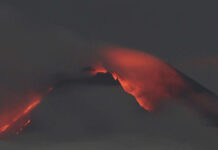
The eerily beautiful images of irrepressible forces of nature go around the world. Up to 1000 degrees hot lava plunges into the sea on the volcanic island of La Palma. Toxic vapors rise from the boiling water.
Santa Cruz de La Palma – On the eleventh day of the volcanic eruption on La Palma the time had come: The scorching hot lava flow reached the west coast of the small Canary Island and has since plunged over a 100 meter high cliff into the Atlantic.
Authorities warned of dangerous fumes. “The lava has reached the sea,” tweeted the Spanish Institute of Oceanography early Wednesday morning and published impressive pictures taken by one of its ships.
#LaPalma volcano lava flow fall from the cliff west of Todoque. Cone formation of volcanic deposits and water vapor clouds and degassing in campaign of @IEOoceanografia @gemar_ieo @sgeologica @ IGME1849 @IGeociencias @VulcanaIEO pic.twitter.com/zV3nDhcAys
– Juan-Tomás Vázquez (@JuanTVaz) September 28, 2021
On them you can see how the glowing orange mass pours like a waterfall over cliffs into the black Atlantic. Then at dawn the huge clouds of evaporating sea water became visible. A pyramid of lava formed off the coast. The pictures are reminiscent of Hawaii, where such elemental forces of nature have long become a tourist attraction.
However, many people on the island were not in anticipation of well-off visitors on Wednesday. “We’re all very nervous because we don’t even know what’s coming. You can’t sleep at all, ”said Rafael from Tazacorte on TV. The main concern was the vapors rising from the sea, which contain, among other things, highly corrosive hydrochloric acid.
It arises when the lava, which is 1000 degrees Celsius, falls into the sea, which is only 20 degrees warm and contains chloride, one of the building blocks of hydrochloric acid. Hydrochloric acid can cause burns to the skin, severe breathing difficulties and irritation of the eyes. In addition, tiny volcanic fragments can form, which could lead to injuries in the lungs, warned the volcanologist Claudia Rodríguez.
Curfews as a precaution
As a precaution, the authorities had therefore imposed a curfew on four smaller districts with around 300 residents. People should keep doors and windows closed. The Canarian Security Authority tweeted: “When you are outside, find a safe place to take refuge.” Outside you should at least tie a wet cloth over your mouth and nose. Despite all the misfortune, the strong wind was at first sympathetic to the people and blew the plumes out to sea.

The volcano now spits out more lava than at the beginning, which rises from greater depths and is therefore hotter, thinner and therefore flows faster. In the Spanish media there is therefore talk of an “outbreak like in Hawaii”.

Since the beginning of the eruption on September 19, the glowing mass has already carved a path of devastation through the valley of Aridane, the particularly fertile part of the island. Around 600 buildings burned and were buried forever under the several meters thick layer of lava.
Perhaps just as bad for people in the long run is the loss of banana plantations. About half of the island’s population lives directly or indirectly from banana cultivation, which was already in crisis before the volcanic eruption.
According to media reports, around 15 percent of the normal harvest at this time of year has been lost due to the volcanic eruption. On its unstoppable journey towards the sea, the lava had also destroyed greenhouses near the coast. Their plastic sheets and artificial fertilizers stored there caught fire, and toxic fumes were also released. In the fields buried under the lava, agriculture will no longer be possible for decades.
Damage of several hundred million euros
The volcanic island was declared a disaster area on Tuesday. Around 5,600 evacuees had to stay with relatives in other parts of the island or in emergency shelters. According to estimates by the regional government, the damage amounts to several hundred million euros.
The volcano in the Cumbre Vieja ridge in the south of the island off the west coast of Africa erupted on September 19 for the first time in 50 years. How long he would remain active, even volcanologists could not say. It could take weeks or months. dpa