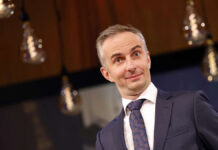
In Markus Lanz’s ZDF talk, there is a tense political skirmish between the left and the FDP.
Berlin – Football is also being used more and more consciously as a political stage: At the start of the German European Championship, a Greenpeace glider flew into the Munich arena and seriously injured two men in an emergency landing. Sharp criticism of the action followed. When Greenpeace activists used to chain themselves to oil platforms or use rubber dinghies against large whalers, they at least only endangered their own lives: but here the lives of bystanders were endangered.
If he were a terrorist now, explains Alexander Graf Lambsdorff, diplomat and FDP politician, he could take this as an example, write Greenpeace on a glider and get a free flight ticket. The Austrian lawyer and world chief reporter Anna Schneider agrees with him that there is a fine line between eco-activism and criminal offense, as well as between non-profit and publicly dangerous. Greenpeace cannot afford everything either. It was a “disservice”, emphasizes Lucas Vogelsang, journalist, author and presenter of a weekly football podcast: an act that is done with a good intention but ultimately has bad consequences.
Markus Lanz: Crossing borders at Greenpeace
However, Greenpeace has always lived by crossing borders in order to highlight existential questions that point to the endangered lives of everyone, Katja Kipping, former party leader of the Left, tries to analyze. Alexander Graf Lambsdorff is almost a euphemism: something like this should not be trivialized and evaluated objectively. It clearly shows the vulnerability of a large event and thus a threat.
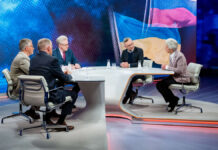
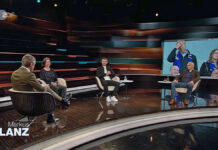
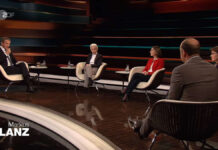
The guests at Markus Lanz (ZDF)
| Katja Kipping | former party leader of the left |
| Alexander Count Lambsdorff | Diplomat and FDP politician |
| Anna Schneider | Chief Reporter of the World |
| Lucas Vogelsang | Writer and producer of a football podcast |
Markus Lanz would also like to address the escapade of Cristiano Ronaldo, who cleared two Coca-Cola bottles from the table at the press conference and obviously preferred to advertise water. Katja Kipping tries to convey in general that football is always also political, also with regard to the blood-soaked lawn through the award of the football World Cup in 2022 to the regime in Qatar.
The discussion expands and loses focus a bit on Cristiano Ronaldo, which he probably wouldn’t have liked. As an exception, Markus Lanz does not interrupt here, but Lucas Vogelsang brings the focus back: “If the largest continental advertising medium pushes a sponsor of this European championship aside, then that is a worst-case scenario.” also the stock exchange price of Coca-Cola. ”How vulnerable is the whole system to the strength of an individual?
Talk on ZDF: Markus Lanz talks about the European Football Championship
Christian Eriksen’s cardiac arrest is also a sensitive issue. Shouldn’t Uefa have set an example here to protect the emotionally troubled team? Or only counts: The show must go on? Also on ZDF in the broadcast: How quickly would those responsible have to leave the voyeuristic gaze of the camera and show empathy? Anna Schneider is in an exceptional situation. Not only for the players, but also for the terrified audience, both in the stadium and on the monitors. Is it more humane to look away or to stick with it and suffer?
Lucas Vogelsang is completely in his discussion profession here. Kneeling down in football as a show of solidarity with the “Black Lives Matter” movement and as a sign against racism is also moving the political discussion: not every fan supports something like this. But such human gestures stay in the memory more intensely and effect more than just a banner, which is carried impersonally through the picture. Football is closer to people here and sport becomes a reflection of society. The camera remains focused on the suffering and while the Belgian players kneel down, the Russian players stand demonstratively. Statements are also set in this way.
Putin and Biden are discussed in the ZDF talk at Markus Lanz
Also in the political meetings beyond sport: like in the meeting of Joe Biden and Vladimir Putin. Some would have thought that Biden would have to apologize for saying that Putin was a murderer, Alexander Graf Lambsdorff once again clearly and vividly describes the initial situation. There was Obama’s statement in 2014 that Russia was a regional power, a much greater violation, Katja Kipping enthusiastically agrees. Russia is a world power and the meeting establishes that too. The regime is militarily a bigger one, with excellent engineers and technicians and in this area on par with the Americans and the Chinese.
Of course, conversations are needed, says Katja Kipping, but there is no Kremlin astrology around it, into which things can be interpreted again. She still feels connected to Russia and there is a hardening of the mood in the Russian population and the sanctions policy has not helped to loosen it up. Count Alexander Lambsdorff agrees that democratic elections are hardly conceivable. The opposition is fleeing or being imprisoned. Massive intimidation. Putin definitely does not want images of the kind going out from Belarus into the world.
Anna Schneider questions whether it is in the nature of the left to have a smooth relationship with Russia. Katja Kipping immediately tries to make it clear that, in her understanding, the EU should neither orient itself clearly towards Russia nor towards the USA, but should find an independent position. They wanted an independent position for the EU, disarmament and even a policy of détente. The left called for the dissolution of NATO and its own security system with Russia involved, Markus Lanz reads from his notes.
Markus Lanz (ZDF): Kipping against Lambsdorff
Thereupon a deepening exchange of blows breaks out between Katja Kipping and Alexander Graf Lambsdorff, which now makes it clear that the community of values in the West is much larger than just NATO – and integrates all the countries whose constitution is based on the basic idea of freedom. But the West must always weigh up the interests. Germany needs allies in a military way. Katja Kipping doubts, however, whether security can still be guaranteed with armament these days. Alexander Graf Lambsdorff intervenes again, knowing one’s own interests, the European interests, the interests of all other actors are a constant process of weighing up.
Lambsdorff explains: The states have an interest in each other and find compromises. Compromises that would also have consequences. In 1994, for example, Ukraine surrendered nuclear weapons to Russia against Russia’s promise to be protected. And now the country is being punished for wanting a policy of détente and disarmament. Russia is pursuing a devastating aggressive foreign policy, which all other countries are looking closely at and considering what consequences they would draw from it. Isn’t NATO therefore a safeguard in order not to become just as vulnerable?
ZDF talk Markus Lanz
Markus Lanz’s broadcast on June 16, 2021 in the ZDF media library for viewing
FDP and LInke are not getting closer – not even with Markus Lanz (ZDF)
Despite all these arguments, Katja Kipping stubbornly sticks to her position that there must be a turn to disarmament and a policy of détente, because the world would not be made safer if more bombs and weapons were manufactured. The money is needed more elsewhere: Germany has a social division, the reverberating effects of the pandemic with a weakening of the health system and the climate catastrophe. A socio-ecological turnaround is simply needed.
“Radio Moscow is on the air when the people from the left are at the lectern,” interjects Count Alexander Lambsdorff laconically. Even today, the left and the FDP are not getting any closer. Not even with other questions in the other social voodoo. Alexander Graf Lambsdorff makes this very clear. The two parties will never form a coalition. And there will be no tax increase at the FDP. Point and final whistle. (Tina Waldeck)