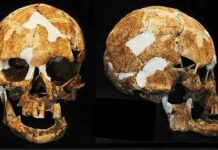
A team of researchers from different institutions coordinated by experts from the Max Planck Institute for the Science of Human History, in Germany, has found that at least 220,000 years ago Neanderthals incorporated DNA from a human group from Africa, closely related to the ancestors of modern humans .
As these scientists explain in an essay published in Nature Communications , to determine this they have analyzed a femur of a Neanderthal found in 1937 in the Hohlenstein-Stadel cave , in southwestern Germany, which still contains remains of mitochondrial DNA . This is located in the mitochondria, organelles that produce energy in cells and are transmitted through the mother. From the mutations that occur in it, it is possible to distinguish different populations and even establish the time that has passed since two subjects shared a common ancestor.
In this way, they have discovered that a female of the lineage that would eventually give rise to Homo sapiens in Africa mated with a male Neanderthal sometime between 470,000 and 220,000 years ago. Their descendants would spread that genetic fingerprint so that, over time, African mitochondrial DNA would end up replacing that of Neanderthals.
Other researchers point out that it is better to be cautious and study more remains to try to elucidate this issue since, until now, the analysis of Neanderthal nuclear DNA – the one found in the nucleus of cells – relates them more to Denisovans, another human species whose remains have been found in Siberia.
In a statement to the Scientific News and Information Service, the Archaeogenetics expert Cosimo Posth, from the aforementioned German institution, one of the co-authors of this work, states that “mitochondrial DNA –transmitted by the mother– and nuclear DNA –inherited by both parents – provide two different stories. The first places Neanderthals closer to modern humans, while the second brings them closer to Denisovans. In fact, the mitochondrial DNA found in Neanderthals came later from Africa and replaced the existing with it, more similar to that of our species . “
However, Posth and his collaborators assume that the migration from Africa that caused this genetic introgression must not have been very significant, since it did not alter the nuclear DNA of the Neanderthals.
Oleg Kuchar / Museum Ulm