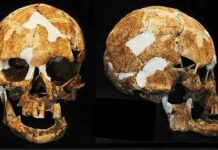
In 1994 the first human remains were discovered at the Gran Dolina de Atapuerca site, a revolutionary finding that had a great impact on the scientific community. In 1997, the team of archaeologists led by Juan Luis Arsuaga, José María Bermúdez de Castro and Eudald Carbonell published in the journal Science the description of this new species: Homo antecessor , a hominid with a surprising mix between primitive and modern characters.
Their discovery contradicted the prevailing theory, which indicated that the first humans would have arrived in Europe around 500,000 years ago: the remains of Atapuerca were much older, about 800,000 years ago. The article generated much controversy, as its authors also defended, based on the morphological analysis of the remains found, that H. antecessor would be the common ancestor of a group that would later give rise to Neanderthals and modern humans.
Now, the journal Nature publishes a work that reveals the results of the protein sequencing of tooth enamel from these fossils using a technique based on mass spectrometry. The analysis provides evidence of a close relationship between Homo antecessor, Homo sapiens, Homo neanderthalensis, and Denisovans . ” Our results support the idea that Homo antecessor was a sister group to the group of hominids of which Neanderthals, modern humans and Denisovans form , so we must assume that the phylogenetic trees we have obtained describe well the kinship relationships between these groups of hominids. ”, Explained Frido Welker, researcher at the University of Copenhagen and first author of the work.
“Much of what we know so far is based on the results of ancient DNA analysis or observations of the physical shape and structure of fossils. Due to the chemical degradation of DNA over time, the oldest human genetic material recovered to date barely exceeds 400,000 years ”, explains Enrico Cappellini, associate professor at the Globe Institute and main leader of the research group.
“Now, the analysis of ancient proteins with mass spectrometry, an approach commonly known as paleoproteomics, allows us to overcome these limits,” adds Cappellini.
A revolutionary method
Thanks to this new technique, scientists have managed to recover one of the oldest sets of genetic data obtained to date. ” These are the oldest proteins recovered so far in human fossils, ” explains José María Bermúdez de Castro, co-director of the Atapuerca Foundation and who has also participated in the study. “Proteins are formed thanks to DNA, so we could say that the oldest genetic sequences in the history of mankind have been obtained. This, in itself, is already a milestone ”.
The researcher believes that applying this technique to other hominid remains will open a new era in the study of human evolution. And, as the expert indicates, the morphology of the fossil remains provides us with information when we have many individuals, as was the case of H. antecessor : “170 remains were discovered at the TD6 level of the Gran Dolina site in the Sierra de Atapuerca, and this gave us a lot of information about what the species was like. This new work reinforces what we had already said, that it is possible that H. antecessor was at some point in the base that gave rise to a new emerging humanity in which we would be Neanderthals, Denisovans and modern humans ”. However, when we talk about the remains of a single specimen, the information provided by the morphology is very limited. The application of the new technique to these isolated individuals will open, according to the researcher, “a new dimension that is going to have a very important impact in the next five or ten years, ” he concludes.