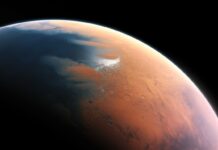
Although it has not yet been confirmed that Mars once supported life, each year we learn more about what the surface of the red planet was like. While evidence has already been found of lakes and rivers of water that furrowed the planet’s surface, the latest find points to an ancient stratified lake, in what is now known as Gale Crater. The NASA- led spacecar Curiosity landed in the crater in August 2012 to study the planet’s surface for ancient lakes or oceans that might have supported life. Now the data collected by the robot has paid off.
As detailed in the journal Science , “geological reconstructions of the Curiosity rover data have revealed an ancient and habitable lake , fed by rivers that drained into the crater.” One of the study’s co-authors and a researcher at the Center for Astrobiology (CAB INTA-CSIC), Alberto González Fairén, for the SINC Agency: “we can affirm with certainty that the habitability window for mesophilic organisms existed in Gale .” It is a stratified lake that could host organisms that prefer moderate temperature conditions , among between 15 and 35 degrees Celsius.
“There is evidence that all the physical, chemical and energetic conditions necessary to establish a habitable environment were present on Mars between 3.8 billion and 3.1 billion years ago.” However, the researcher is cautious : “we must frame Curiosity’s studies well in the spatial and temporal scope that preserves the geology of Gale crater, and not extrapolate too much to the rest of Mars.”
The Curiosity findings allow us to conclude that there were different types of sediment depositions : the rocks that were located in the coastal area of the lake present a thicker stratification, and are rich in minerals product of the sedimentation of oxidizing environments (clays, hematites and oxides of iron). Meanwhile, in the deepest part, other types of materials have been found: much thinner sheets of magnetite and silicon. This difference in materials is a photo of the geological evolution of the crater and confirms the existence of a stratified lake with a chemical discontinuity between surface and deep waters.
Chemical stratification , González Fairén indicates, “is a very common phenomenon in Earth’s lakes .” Furthermore, according to the researcher, “this type of ecosystem offers a huge diversity of favorable environments for the growth of microorganisms.”
But Curiosity is not the only space mission that is exploring whether life could exist on Mars. NASA’s Opportunity astromobile has confirmed that the area known as Meridian Bay also had the right conditions to host mesophilic organisms 4 billion years ago. The same area, some time later, was an acidic environment , “similar to Río Tinto, an environment on Earth located in Huelva, a terrestrial analogue of Mars.”
References:
J. A. Hurowitz, J. P. Grotzinger, W. W. Fischer, S. M. McLennan, R. E. Milliken, N. Stein, A. R. Vasavada, D. F. Blake. (2017). Redox stratification of an ancient lake in Gale crater, Mars. Science. DOI: 10.1126/science.aah6849.