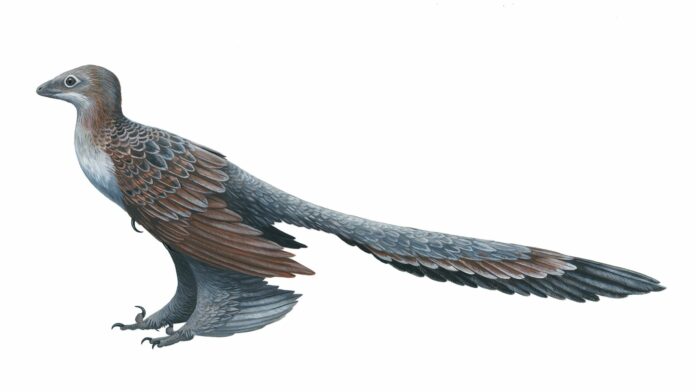
Its name means “long-feathered thief of Yang Yandong”, in honor of the president of Bohai University, who was in charge of giving the necessary financial support to acquire the fossil. It is the only known species of the Changyuraptor genus and lived about 125 million years ago in what is now China, in humid and temperate forest ecosystems.
the biggest feathers
This species belongs to the group of microraptors , predatory dromaeosaurid theropod dinosaurs with aerodynamic capacity. It is characterized by its long feathers on the lower and upper extremities, which gives it the appearance of having four wings . The studied specimen has a length of 132 centimeters from the head to the end of its tail plumage, and its weight has been estimated at about 4 kilos, which would make it one of the largest microraptors known to date . The holotype fossil was described in a study published in the journal “Nature Communications”, which featured Luis M. Chiappe as the lead author of the article, a researcher at the Natural History Museum of Los Angeles County:
“With tail feathers nearly 12 inches long, about 30% of the skeleton’s length, the new fossil possesses the longest known feathers of any non-avian dinosaur.”
But I couldn’t fly
Despite its “four wings” and long feathers, researchers think Changyuraptor yangi could not fly. Instead, it would be a planning specialist . Its feathers spread throughout the body would help it land softly. The length of its tail is understood as a solution to compensate for the weight of its body and thus maintain control while gliding, to land accurately on its prey.
feathered dinosaurs
Fossil remains of Changyuraptor yangi were discovered by farmers in Xijianchang, a town in Jianchang County, Liaoning Province of China. Specifically, it was found in the Yixian Formation, from the Lower Cretaceous , where other specimens as famous as Yutyrannus huali have been found, which, with its 9 meters in length, is the largest feathered dinosaur on record. Although, we are still in the middle of a debate about the feathering or not of many other species of dinosaurs, so depending on how we take the concept of “feather” these conceptions could vary.
The Late Jurassic to Early Cretaceous deposits of northwestern China are famous for their remarkably well-preserved fossils and for harboring a considerable variety of non-avian feathered dinosaurs that have provided the scientific basis for understanding that birds evolved from birds. theropod dinosaurs.
The fossils found in these paleontological sites in China have become the subject of debates about the origin of flight in birds. However, with regard to Changyuraptor yangi , we still need to better understand its anatomy, aerodynamic capabilities and even its phylogenetic location so that it can play its scientific role with certain guarantees in this discussion of flight.
The holotype fossil is composed of a nearly complete skeleton , compressed into a two-sided slab. The skull is poorly preserved beyond its dentition, however, the spectacular state of conservation of the skull towards the tail stands out, with tissue remains, among which the penaceous feathers that covered the entire body of this dinosaur stand out.
fly before the birds
Although we still have much to learn about this species, its value is unquestionable in terms of the clues it offers to study the origin of flight and the transition from feathered dinosaurs to birds . Modern birds often have unfeathered legs and can fly using only two wings, making it clear that the morphology of Changyuraptor yangi and other microraptors follows a different aerodynamic model. One of the hypotheses about the evolution by which the dinosaurs were able to take flight defends the reduction in size as a fundamental element. However, the size and weight of Changyuraptor yangi play into the limits of this theory and could contradict it. That is why many researchers believe that dinosaurs already developed hollow bones, nests and, perhaps, flight, before they evolved into proper birds .
References:
Chiappe, LM et al. 2014. A new raptorial dinosaur with exceptionally long feathering provides insights into dromaeosaurid flight performance. Nature Communications 5, 4382. DOI: 10.1038/ncomms5382.
Choi, C. 2014. Bizarre Dinosaur Had 4 ‘Wings,’ Long Tail Feathers. livescience.com.