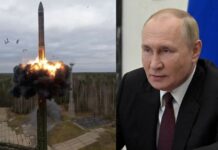
Overall, the number of nuclear weapons is falling, but the nuclear powers have increased their arsenal of operational warheads in 2020.
Stockholm – Since the end of the Cold War, the nuclear powers have committed to dismantling their nuclear arsenals. But this trend seems to have stalled in 2020. Although the number of nuclear warheads worldwide fell from 13,400 to 13,080 within a year, more nuclear weapons were put into operational readiness. This was announced by the Swedish Peace Research Institute in Stockholm (Sipri) on Monday (14.06.2021).
About 105 nuclear warheads were made operational in the past year. As a result, the number of operational nuclear warheads rose from 3720 to 3825 in 2020. Around 2000 of them were put on high alert, most of them in Russia and the USA. Both the USA and Russia had further reduced the number of their nuclear weapons through decommissioned warheads last year. However, both had an estimated 50 more nuclear warheads in use in early 2021 than a year earlier, Sipri said.
Nuclear weapons disarmament: stalling trend according to Sipri “worrying”
Russia added around 180 warheads to its military nuclear arsenal. This is mainly due to the stationing of additional land-based intercontinental ballistic missiles (ICBMs) and sea-based ballistic missiles with multiple warheads. Both states adhered to the limits set out in the New Start Disarmament Treaty. The agreement was only extended in February. There is no limit to the total inventory of nuclear warheads.
“The total number of warheads in global military stocks appears to be increasing,” said Hans M. Kristensen, Sipri’s expert on nuclear disarmament, arms control and non-proliferation. It is “a worrying sign that the downward trend that has characterized global nuclear arsenals since the end of the Cold War has come to a standstill”.
Russia (6255) and the United States (5550) together make up over 90 percent of the world’s nuclear arsenal. Both fund extensive and expensive programs to replace and modernize nuclear warheads, missile and aircraft carrier systems, and manufacturing facilities. “Both Russia and the US seem to be increasing the importance they place on nuclear weapons in their national security strategies,” said Kristensen.
Nuclear powers are modernizing and expanding their nuclear arsenal
But not only Russia and the US are continuing this worrying trend. The other nuclear powers are also building on their nuclear arsenals and investing in their nuclear capacity, and are already planning, developing or deploying new weapon systems. The nuclear powers include the USA and Russia, Great Britain, France, Israel, China, Pakistan, India and North Korea. Great Britain raised the planned ceiling for nuclear weapons from 180 to 260. China is modernizing and expanding its nuclear weapons inventory. India and Pakistan are also in the process of expanding their nuclear arsenals. North Korea is further expanding its military nuclear program as a central element of its national security strategy.
The International Campaign for the Abolition of Nuclear Weapons (Ican), which was awarded the Nobel Peace Prize in 2017, reported in early June that the nuclear powers had increased spending on their arsenals by $ 1.4 billion in 2020 despite the corona pandemic ) increased to $ 72 billion.
It is “alarming news” that the “atomic arms spiral” is continuing, said Greenpeace spokesman Christoph von Lieven in Hamburg. Germany also shares responsibility for the planned acquisition of the F-18 fighter jets that are capable of nuclear weapons. The Greenpeace spokesman called on the next federal government to suspend the planned acquisition of the fighter jets and to ensure the withdrawal of the US nuclear weapons stationed at the Bundeswehr air base near Büchel in Rhineland-Palatinate. (David Suárez Caspar with afp)