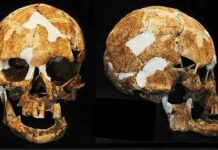
It had already been more than eleven years since their discovery, but the appearance of the mysterious Denisova men was until now a mystery. And it is that these hominids, very closely related to Homo sapiens and H. neanderthalensis , were identified only from a fragment of the little finger and several teeth found in the Siberian cave that gives them their name. Later, earlier this year, Nature magazine echoed the discovery of the remains of a jaw on the Tibetan plateau that would also have belonged to the Denisovans.
This extinct species was the first hominid identified from its genes, and it is thanks to DNA that we have today, for the first time, the first portrait of Denisovans. Lacking skull remains to give a clue to the possible appearance of our relatives, researchers have resorted to a novel technique that has analyzed epigenetic changes in certain regions of the DNA of the Denisova pinky phalanx to reconstruct the appearance of a girl who would have lived in Siberia 80,000 years ago. “The mere fact that DNA can be used to predict the anatomy of an extinct species is impressive,” explains Bence Viola, one of the paleontologists at the University of Toronto who participated in the study.
Mapping DNA methylation
DNA methylation (addition of methyl groups, made up of one carbon and three hydrogen atoms) is an epigenetic process by which cells can ‘turn’ or ‘turn off’ certain genes, thus regulating their activity, and has a lot of influence in development, in the appearance of diseases and in the determination of most biological traits.
Since the methyl group degrades after death, it cannot be detected in fossil DNA. But the team co-led by Liran Carmel, a computational biologist at the Hebrew University of Jerusalem, discovered a way to identify the parts of ancient DNA that had once been methylated by analyzing patterns of chemical damage that accumulate in DNA over time. weather. In this way they were able to identify different genes that were silenced in Denisovans, but not in Neanderthals and modern humans.
The next step was to compare them with the databases of epigenetic modifications in human tissue, for which the impacts on gene expression are known, and in this way they obtained a list of hundreds of genes for which the expression levels probably differed. between archaic groups and modern humans. To connect this list with anatomical features that would affect the appearance of Denisovans, the researchers analyzed another database, which lists the physical effects of genetic mutations in people with rare conditions. According to the authors, the reduced gene expression caused by DNA methylation would be roughly analogous to the effects of disease-causing mutations.
The appearance of the Denisovans
According to the conclusions of the analysis, which are published in the journal Cell , Denisovans probably would have shared certain features with Neanderthals, such as an elongated face and a wide pelvis, but would also have other derived features such as increased dental arch and cranial expansion side.
The jaw that came at the right time
In order to verify the reliability of their method, the authors made a simulation to predict the anatomy of Neanderthals from their genome, a well-known group with hundreds of fossils, so many details of this are known. your anatomy. The result was a match of between 85 and 90% of the predicted traits.
In addition, the discovery of the jaw on the Tibetan plateau earlier in the year came out of the blue, and served as a reinforcement test: with their method, scientists had managed to correctly predict several of the features of this bone when it was not even known. had proof of its existence.
Reference: Gokhman et al. 2019 Reconstructing Denisovan Anatomy Using DNA Methylation Maps. Cell 179 (1) 180-192