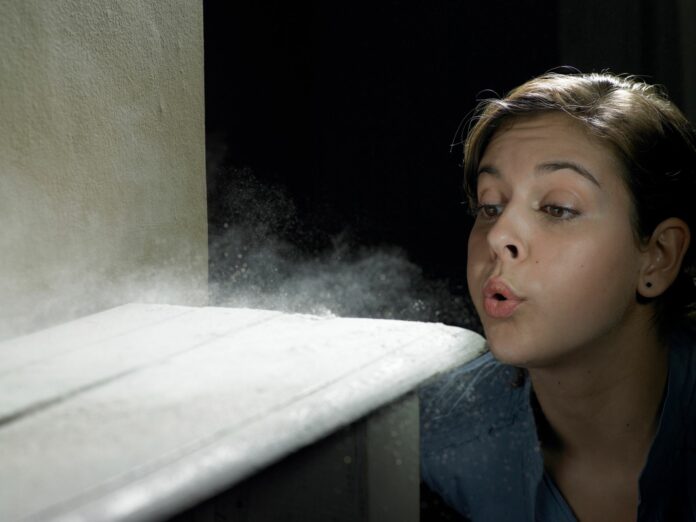
Except for those lucky enough to pay to have their house cleaned, the rest of us mortals must spend considerable time keeping our home in a more or less tidy state. The truly depressing thing is that no matter how hard we try, the house is going to continue to be dirty. Floating in the atmosphere of our homes is a reservoir of more than 10 million tiny foreign objects per cubic meter: bits of asbestos, bits of melted tire, flakes of skin, sea salt, sand from the earth’s deserts, and much more. we know by the generic name of dust. All these particles take from hours to weeks to settle on furniture, shelves, books, televisions and floors, in a constant and practically imperceptible rain.
sand around the world
Much of that dust comes from places as far away as the Gobi desert, the Sahara or the Mojave. In fact, desert sand travels the globe in a few weeks. It is not due to the sandstorms, but to the incessant breezes that blow at a speed between 8 and 15 kilometers per hour . The sandy dust that is set in motion every day by the action of other sand particles turns out to be about 100 million tons per day. Most rise to an altitude of 8 to 10 kilometers high and will cover perhaps half the globe before falling after several weeks of travel. And it is that at that height there is an intense current of air that was discovered during the Second World War. That “jet wind” travels at about 10,000 kilometers per hour and was felt by bombers during their missions.
By the way, the paradigm of changing phenomena at the planetary level is weather. Atmospheric forecasting is really a very difficult task, especially considering that the “memory” of the atmosphere is about five days. This means that in the course of a working week, atmospheric phenomena have erased any indication of the pressure, temperature or humidity conditions that existed before. Let’s keep that in mind when we rant against the “men and women of the time”.
Not only sand falls from the sky. Every year the mass of the Earth increases by several tons due to small micrometeorites and cometary particles that do not disintegrate when entering the atmosphere. Any of us can collect them simply by leaving a clean bucket of water outside on a rainy day. When the sun rises, it is covered with plastic and the water is allowed to evaporate: at the bottom there will be a fine dust that has been dragged by the rain. Some of it will be desert sand, but if we hold a magnet close to it, some of those particles will stick to it. A large number of them will be micrometeorites that floated in the air until a drop dragged them to the ground…
The physics of dusting
To collect these spoils, since time immemorial we have used the everlasting broom. To the surprise of many of us, the broom not only pushes the dirt, but behind each of its strands there is a partial vacuum that sucks up the dust. That is a detail that no one noticed until one afternoon in 1901, in the hotel at St Pancras Station in London. The presentation of the latest model of apparatus for cleaning wagons was held there. Among the visitors was H. Cecil Booth, a famous builder of Ferris wheels for amusement parks. One of his creations is fondly remembered by film buffs: the Prater Ferris wheel in Vienna, which appears in the film The Third Man .
The apparatus in question was a compressed air generator and it cleaned the dust by blowing. But Booth had the brilliant idea of making it work backwards, sucking. Eager to check it out, as soon as he got to his office he dropped to his knees, pressed his lips to the rug, and began to absorb like a man possessed. He almost choked on the dust he had absorbed, but he proved his idea worked: thus the vacuum cleaner was invented.