Today is the birthday of the Mexican writer and 50 years have passed since the publication of her book “La noche de Tlatelolco”, the reconstruction of the historic popular protests in Mexico City in 1968, which left dozens of students dead and look very similar to the current demonstrations in Colombia.
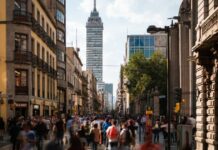
They are many. They come on foot, they come laughing. They came down through Melchor Ocampo, La Reforma, Juárez, Cinco de Mayo, boys and girls students who go arm in arm in the demonstration with the same joy with which they went to the fair just a few days ago; carefree young people who do not know that tomorrow, in two days, in four they will be there swelling in the rain, after a fair where they will be the center of the target shooting, target children, children who marvel at everything, children for those who every day is a holiday, until the owner of the target shooting barrack told them to form like this next to each other like the strip of silver chicks that advances in the games, click, click, click, click and it passes to eye level, Aim, fire !, and they bend backwards brushing the red satin curtain. (We recommend: Follow the national strike live).
The owner of the barrack gave the rifles to the CUÍCOS, to those of the army, and ordered them to shoot, to hit the target and there were the silver monkeys with the azure in their eyes, gaping at the barrel of the rifles. Fire! The green flash of a sparkler. Fire! They fell but were no longer bouncing up on a spring to be thrown again the next turn; the mechanics of the fair were different; the springs were not made of wire but of blood; a slow and thick blood that was puddling, young blood trampled in this burst of lives throughout the Plaza of the Three Cultures. (More: Follow the strike in Bogotá).
Here come the boys, they come to me, there are many, none of them have their hands up, none of them have their pants fallen between their feet while they are undressed to search them, there are no surprise punches or blows, no harassment, or vomiting from the torture, or shoes piled up, take a deep breath, walk confidently, stomp, stubborn; They come around the Plaza de las Tres Culturas and stop by the edge where the Plaza drops two or three meters so that the Pe-Hispanic ruins can be seen; They resume their march, there are many, they come towards me with their hands that raise the banner, childish hands because death children their hands; they all come in tight lines, happy, they walk happy, pale, yes, and a little smudged but happy; there are no longer bayonet walls that violently reject them, there is no longer violence; I look at them through a curtain of rain, or it will be tears, just like the one in Tlatelolco; I can’t make out his wounds, how nice, there are no more holes, no bayonets, no expanding bullets; I see them cloudy but I do hear their voices, I hear their steps, pas, pas, pas, paaaaas, paaaaaas, as in the manifestation of silence, all my life I will hear those steps that advance; Mini girls with their young sunburned legs, teachers without ties, boys with the sweater tied around the waist, around the neck, they come on foot, they come laughing, they are many, they come with that crazy joy that is felt when walking together in this street, our street, towards the Zócalo, our Zócalo; here they come; August 5, August 13, August 27, September 13, Father Jesús Pérez blew up the cathedral bells to receive them, the entire Plaza de la Constitución is illuminated; constellated with thousands of cempazúchitl, thousands of candles; the boys are in theheart of an orange, they are the highest burst of fireworks, wasn’t Mexico sad? I see him happy, what crazy joy; They go up Cinco de Mayo, Juárez, how much applause, the Reformation, they are joined by three hundred thousand people that nobody carries, Melchor Ocampo, Las liornas, they go back to the sierra, the forests, the mountains, Mexico, Li- ber-tad, Me-xi-co, Li-ber-tad, Me-xi-co, Li-bertad, Me-xi-co, Li-ber-tad, Me-xi-co, Li-ber-tad.
 Follow the news of El Espectador on Google News
EP (We recommend: Elena Poniatowska won the Premio Cervantes de las Letras in 2013).
It’s not that I “got into” the Student Movement; I was already inside for a long time. Understand me, I’m from the Poli; I have my house there; there are my friends, neighbors, work … My children were born there. My wife is also from the Poli. We have carried the Movement within for many years. Here there is no improvisation, no “stitch”, no “good vibes”, or anything! It’s not about that. It is about defending everything we believe in, for which we have always fought and before us our parents and our parents’ parents … We come from families of workers, from people who have always worked, and worked hard. • Raúl Álvarez Garfa, mathematical physicist from the ESFM. Professor at the National School of Biological Sciences of the IPN, delegate to the CNH, imprisoned in Lecumberri.
ME-XI-CO-LI-BER-TAD – ME-XI-CO-LI-BER-TAD – ME-XI-CO-LI-BER-TAD • Choir at the demonstrations
I joined the Student Movement because one day, without further ado, the grenadiers arrived at the School of Fine Arts with police dogs and chains and took everyone prisoner, like that, look, with their hands on their hips. And the INBA had not even said openly whether or not it supported the Movement! (I think rather than not, eh?) For many actors, this arbitrary invasion made us aware and we resolved to unite with the students and help them, but really, not only going to the demonstrations arm in arm or shouting at the rallies. .. Then we constitute a brigade of theater actors. • Margarita, Isabel, actress.
JOIN-PEOPLE – JOIN-PEOPLE – JOIN-PEOPLE – JOIN-PEOPLE • Chorus in the demonstrations
The decision we could make was not to join the Movement but to stay or leave. From the beginning, we had a more or less clear awareness of what was going to happen — the repression, the massive arrests, the mechanics were swift — then the alternative arose. Either “you do the clandestine”, which means to take a plane or train ticket or whatever and leave, or you stay in the city to see how it turns out … We were all in our schools, Raúl in Physics-Mathematics, I in Philosophy, and we had previously participated in student issues. For example, the specific problems of my school were: the Popjilar High School, the rejected ones, the freedom of Vallejo, the study plans and other academic ones, the independence of the College of Psychology, and so on. Since 1967 I was the president of the Alumni Society but now I am for life … As of July 26, everything changed … I am not the same; we are all others. There is a Mexico before the Student Movement and another after 1968. Tlatelolco is the split between the two Mexicos. • Luis González de Alba, delegate of the Faculty of Philosophy and Letters of the UNAM before the CNH, imprisoned in Lecumberri.
“Doing the clandestine” means doing nothing. • Gilberto Guevara Niebla, delegate of the Faculty of Sciences of the UNAM before the CNH, imprisoned in Lecumberri.
I think that the strength and importance of the Student Movement came from the repression. More than any political discourse, the very fact of the repression politicized the people and made the vast majority participate actively in the assemblies. It was decreed that in each school there would be strikes and right there the idea of the brigades and the fighting committees in each Faculty arose. The brigadistas were boys and girls from the student base who carried out all kinds of activities, from collecting money to holding lightning rallies in the streets, in the most remote neighborhoods, in the proletarian colonies. The large demonstrations were one of the most effective political weapons of the Movement. • Carolina Pérez Cicero, student of the Faculty of Philosophy and Letters of the UNAM.
Spontaneous demonstrations as large and so extraordinarily alive as the student ones have never been seen in Mexico. There was one, I think, of support for the Cuban Revolution, many years ago, but it did not have that size. In reality, the Student Movement shook Mexican society and that is why the government began to be so afraid. • Félix Lucio Hernández Gamundi, from the ESIME of the IPN delegate to the CNH, imprisoned in Lecumberri.
The marches in Mexico had been, at most, fifteen thousand protesters. But six hundred thousand people from all sectors of the population, and especially young people! When had anything like this been seen? How was the government going to put up with it? No wonder the marble was thrown away. • Salvador Martínez de la Roca, Pino, from the Wanted Committee of the Faculty of Sciences of the UNAM, imprisoned in Lecumberri.
It was not tolerable for a true crowd of between three and six hundred thousand people to parade through the main avenues of Mexico, Paseo de la Reforma, Juarez, Cinco de Mayo, carrying banners and banners that mocked the “principle of authority.” The student protest that was shaking the status quo, the PRI, the charro unionism, the “moimza” had to be crushed. • Eduardo Valle Espinoza, Buho, delegate of the National School of Economics of the UNAM to the CNH, imprisoned in Lecumberri.
By marching through the streets as we did, in a certain way we avenged all the students in the province who were repressed before it was our turn; to the students of Puebla, Tabasco, Chihuahua, Sinaloa, Guerrero, Sonora, and, in a way, the abuses committed in Morelia, in Hermosillo, in Monterrey. • Ernesto Hernández Pichardo, from the National School of Economics of the UNAM.
SOLDIER, DO NOT SHOOT, YOU ARE ALSO THE PEOPLE. • Manta at the August 27 demonstration.
* “The night of Tlatelolco: Oral history testimonies” is a work published by Ediciones Era in 1971 and can be purchased at www.edicionesera.com.mx or via Amazon. It is a chronicle of the Mexican journalist Elena Poniatowska based on the student massacre – of between 50 and 300 young people – that occurred during October 2, 1968 in the Plaza de las Tres Culturas, located in the Nonoalco Tlatelolco Urban Complex, in Ciudad from Mexico.