We present the second part of an article that, from the perceptions of art, seeks to reflect on the moment the country is going through with the national strike and the symbolism of the presence of the indigenous minga in Cali last week.
In recent days, the press and social networks have reflected on some of the historical reasons that led Cali to the social outbreak that it has starred in within the framework of the current national strike. The capital of the Valley is referred to as a time bomb that was concentrated through ailments, miseries, displacements and ambitions that have been merging in recent decades. Throughout these decades, art or, rather, different types of art, have had an echo in that sector of the Colombian Pacific, with the appearance of, among others, a landmark such as Caliwood.
Once, the Cuban writer José Lezama Lima mentioned the differential axis between European romanticism and American romanticism: while in Europe the writers raised their pens to narrate the bourgeois stories of the 19th century, in America, the armies of Bolívar and San Martín wielded the sword.
We suggest you read: Cali: protest, art and dignity
From rock art found in caves in Europe, to Bansky’s graffiti on the West Bank wall, artistic expressions have interpreted and re-signified the world, the time or the context in which they arise, thus creating a new perception of that world, time or context, a transformation in the way of understanding its dynamics.
During this national strike, urban art, performance, music, among other artistic forms, have appeared in the midst of the demonstrations. Therefore, in this case, the endless question about the relationship between art and the social dynamisms in which it arises also takes place.
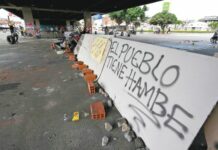
For Lucas Ospina, professor of Arts at the Universidad de los Andes, the artistic expressions that have emerged in the current marches can be analyzed in relation to the idea of the orange economy: “I like to see that images and actions of art do not live only on the screens, or that things are recorded and documented for the archive, for the museum, social networks and the endorphin of likes. That each image is supported by a body that bears it, that makes it its own, that acts on it, that takes risks, and that uses public space to leave traces that contrast with the vandalism of the recruitment posters and urban poverty of his public works. The living arts as a protest against a dead and mercantile culture, such as the one proposed by this Government of the Orange Economy. To understand, justify and forgive the tragicomedy of this country we have to imagine it and, paraphrasing the writer Julian Barnes, one could say: ‘well, at least it produced art, maybe, ultimately, catastrophes are for that’ “.
 Follow the news of El Espectador on Google News
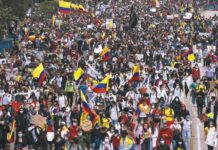
Ospina talks about public space and its use as a stage for social protest, combined with a place for art. From the arrival of the indigenous minga to Cali, some enigmas about the occupation of public space can be perceived. For example, for Professor Miguel Rocha, a researcher at the Center for Ecocritical and Intercultural Studies at the Javeriana University, “the arrival of the minga in Cali has to do with the importance of being at this juncture and confusion. It has been noted with comments on social networks and with the misinformation of what has happened in recent days, that there are still some stereotypes of the wild Indian, the rural Indian, the Indian who must stay in his colonial shelter, who would not be a subject of civil law nor a subject capable of interpellating his countrymen as equals, and that is very far from reality insofar as their presence in the large cities of the country is very significant, since they are not only inhabitants of the towns or reservations in which they are ethnically and cartographically located in the country. Their participation in urban spaces implies a two-way process: to claim that they must return to their territories is to return to that old colonial history of the wild Indian and, on the other hand, it is to take away the rights that they have already won a long time ago, but are still in process. ; they are and we are actors in any process that has to do with institutions and open dialogue in urban, rural or international contexts ”.
On the other hand, the poet Hugo Jamioy adds that “the presence of the minga at this time that Colombia is going through is a call that we all have in our hands something to contribute in the solution that our country requires, it is a call to the president of the Republic, ministers, Armed Forces, mayors, governors, municipal councils, departmental assemblies, artists, all sectors, all people individually and collectively, all cities, all municipalities, is a call to make an intellectual contribution, an economic contribution, a contribution from the workforce. Each one has a contribution to make to this country and that is the true meaning of the minga ”.
You might be interested in reading: Statement by artists and academics in Mexico in the face of the social crisis in Colombia
That is to say, the reflection of a movement such as the minga is that in the meeting of different social subjects in the streets, various dialogues and exchanges can take place that contribute to the requests of the sectors that are manifested, without ignoring the oppositions to these sectors: a cultural exchange between different voices and social positions. And in that exchange of contributions and disagreements, we can think of the idea that while in Europe romanticism arose in the midst of the advance of modernity, in geographies such as America, art appears as the American romanticism of the 19th century: between the struggles of independence.
The Brazilian theorist Silviano Santiago, in The Interlugar of Latin American Discourse, tried to explain the place of enunciation of Latin American artists and writers, taking into account that the history of art, as well as art itself, has been positioned from discourses and forms European. Santiago takes the short story Pierre Menard, author of Don Quixote, by Jorge Luis Borges: Pierre Menard is a novelist who wants to write Don Quixote, but not Cervantes’s Don Quixote, and thinks that Cervantes wrote Don Quixote in moments of inspiration, while Pierre Menard He consciously chooses to write and reflects on how to write Don Quixote, for which Santiago concludes that specifically in contexts such as Latin America, art emerges as a critical and reflective consciousness in the face of the social moment that is being lived.
You might be interested in reading: “100 thousand poets for change”: a collective poem for democracy in Colombia
Therefore, it is not only that artistic expressions reproduce proposals for communication, dialogue and conciliation, but that art has a direct relationship with what goes beyond art: from a position against the orange economy, to feelings of social construction that are proposed in movements such as the minga, there is the common denominator of critical capacity in the face of social conjunctures that, after all, in contexts like ours and perhaps since before the 19th century, end up emerging in the art.