
On the decline of the psychoanalytic profession. The column “Dr. Hontschik’s diagnosis”.
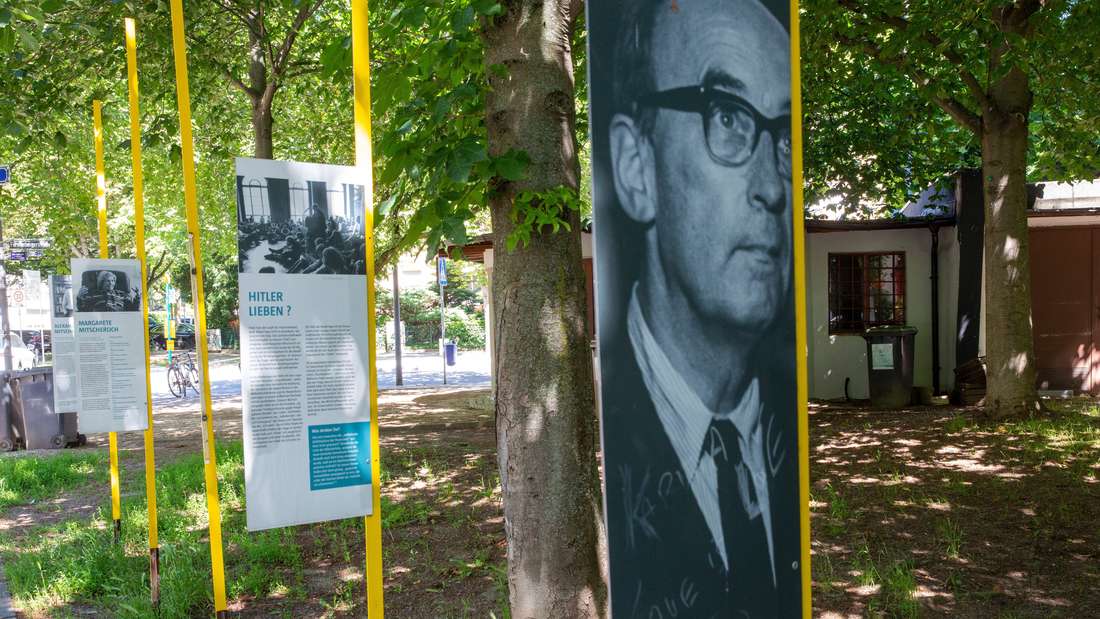
What looked from afar like the coffee break of a trip group from the old people’s home turned out to be a protest event on closer inspection. Six weeks ago, fifty psychoanalysts and friends gathered in the middle of Frankfurt’s Westend to commemorate the tenth anniversary of Margarete Mitscherlich’s death at Mitscherlichplatz. But why did they protest?
Alexander Mitscherlich (1908-1982) observed the Nuremberg Doctors’ Trial in 1947 on behalf of the medical associations. He was supposed to “avert collective guilt from the medical profession”. However, his ruthless depictions of the medical crimes of the Nazi doctors in the book “Medicine without Humanity” described the opposite, and Mitscherlich was insulted, slandered and ostracized in the medical profession – until the end of his life.
The book was no longer available shortly after publication! In 1950 Mitscherlich built up psychosomatics at the Heidelberg University Clinic. In 1960 he founded the Sigmund Freud Institute (SFI) in Frankfurt am Main, and only much later was he appointed professor – not in medicine, but in the philosophical faculty. “Illness as Conflict”, “On the Way to a Fatherless Society” and “The Inhospitality of Our Cities” were the titles of other of his widely acclaimed writings.
Margarete Mitscherlich (1917 to 2012) met him in Heidelberg and they married in 1955. After moving to Frankfurt, she worked as a training analyst at the SFI. In 1967 they both published The Inability to Mourn. In this work they described the Germans’ strategies of denying the crimes of the Nazi era and brought to light their concealed entanglements of guilt and complicity. The sudden loss of the “Fuhrer” did not trigger grief, but denial and forgetting. With this book they shook the full self-righteousness of the German post-war period, were violently attacked and are still quoted to this day.
After Alexander’s death in 1982, Margarete continued to work for almost thirty years. She was the first German analyst to criticize the male-centric Freudian theory, in which the female only appeared in the form of a defect, i.e. the absence of a penis. She rejected this theory, questioned the general meaning of the Oedipus complex and denied that there was a common genital phase in the psychosexual development of the sexes. With her book “The Peaceful Woman” she again caused a broad social debate.
Alexander and Margarete Mitscherlich were formative for the German post-war history and for the city society in Frankfurt am Main. But at the same time that both have been increasingly forgotten today, their profession, psychoanalysis, has been in rapid decline and is increasingly being pushed to the fringes of psychology and medicine. One professorship after the other is axed, not filled again or integrated into behavioral therapy teaching, also and especially in Frankfurt. In the meantime, there is only one of the more than one hundred chairs of clinical psychology that is oriented towards depth psychology: in Kassel.
Behavior therapy is modern and up-to-date, it can be applied quickly and inexpensively in its result orientation. Psychoanalysis, on the other hand, is a thing of the past because it deals with the uniqueness of the individual in his or her life history, treatment can take years and can hardly or not at all be evaluated.
In Frankfurt’s Westend, a small green area with a roundabout in the middle has been named Mitscherlichplatz. Because the surrounding area belongs to an investor who has been tormenting those living there for many years with a never-ending modernization of the high-rise building there, the place is in a pitiful state. “It reflects the decrepit condition – Mitscherlich called it ‘inhospitable’ – psychoanalysis is in,” said one protest speaker. And the average age of the protesters, which can safely be estimated at seventy or more, reflects the fact that the enthusiastic young supporters of psychoanalysis of the seventies have almost lost touch with today’s scientific discourse.
The decline of Frankfurt psychoanalysis is no glorification for the Goethe University. And the condition of Mitscherlich-Platz is no glorification for the city of Frankfurt am Main.


