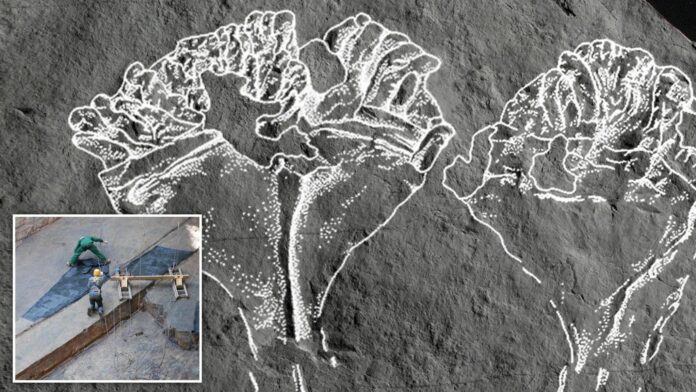
The oldest predatory animal that we know of to date is 560 million years old and is called Auroralumina attenboroughii .
It is a species classified as a precursor of the cnidarians, a disparate and ancient group that includes corals and jellyfish and occupy the pelagic and benthic kingdoms, so we would be dealing with specimens that live from the surface to the seabed. They have a rich fossil record from the Phanerozoic eon, very useful for studying the early history of the group but, although cnidarians diverged from other animals in the Precambrian period, the record we have from the earlier period, the Ediacaran (635-542 million years ago) years) raises many scientific questions.
To help solve them, a group of researchers has found a new fossil :
“It shows two bifurcated polyps encased in a rigid polyhedral organic skeleton with evidence of simple, densely packed tentacles. Auroralumina shows a set of characters that relate it to the first medusozoans”.
Medusozoans go through various stages throughout their lives . Initially they are little more than a mass on the seafloor. They then go into a floating phase in which they are responsible for reproducing. It is in this floating phase that they usually acquire jellyfish shapes. Auroralumina , if it followed these complex cycles, would be in its immobile state, fixed to the seabed.
poisonous tentacles
It is about 20 centimeters long and the body is surrounded by a microbial web that shows no signs of folds. The cup-shaped structures have equal sizes, with a stem about 12 centimeters long and a 6-centimeter “cup”. At the top of each cup, a crest of tentacles can be seen running around the perimeter .
These tentacles would be cnidoblasts, characteristic cells of this group of animals that carry a stinging substance . They were their defense tools against a possible predator, and their weapons to capture their prey . For researchers:
“What’s really interesting is that we think it’s bifurcating, so you have these two cups that are joined near their base, and then there would have been a continuous skeleton going down to the bottom of the sea, which we don’t see. Unfortunately, the fossil it is incomplete”.
More than a decade of study
The fossil was discovered in Charnwood Forest in the Bradgate Formation in Leicestershire, UK, with dates ranging from 557 to 562 million years. The site began to be investigated in 2007, but scientists have needed 15 years to understand what they had in front of them and make sense of the Auroralumina fossil, so it was not until 2022 when the description of this new species was published in the journal “Nature, Ecology & Evolution”.
The investigated material is a single specimen, which has been imprinted in a low-profile relief in a sedimentary rock. It is thought that the fossils found in this formation were washed away by a flow of sediment and ash from nearby volcanic activity. The holotype fossil remains in situ in the rock where it was found , while the cast for study was taken to the British Geological Survey in Nottingham.
a famous site
Charnwood Forest boasts internationally famous finds before this one. One of the most important fossils discovered at this site was that of Charnia masoni , found in the 1950s by students Roger Mason and Tina Negus. It was the first Precambrian fossil known to science . It is a form of life that has the shape of a fern leaf, but scientists defend that it was some kind of animal. A specimen of Charnia masoni appeared 40 centimeters from Auroralumina attenboroughii .
The find has pushed back evidence of animal predation some 20 million years earlier than previously thought. Its name refers to this early age and also pays tribute to David Attenborough for his outreach work on the Charnwood fossils. Auroralumina attenboroughii means “Attenborough dawn lantern” , alluding to the torch-like appearance scientists have seen in the fossil.
Famed scientist David Attenborough was an insistent fossil hunter in the area. He acknowledged that:
“The rocks in which the Auroralumina has now been discovered were then considered so old that they dated back long before life began on the planet. So I never looked for fossils there. A few years later, a boy from my old school [ refers to Roger Manson] found one and proved the experts wrong. He was rewarded with his name given to his discovery. Now I’ve almost caught up with him and I’m really delighted.”
References:
Amos, J. 2022. The extraordinary find of the fossil of the oldest known predator. bbc.com.
Dunn, F. S. et al. 2022. A crown-group cnidarian from the Ediacaran of Charnwood Forest, UK. Nature Ecology & Evolution 6, 1095-1104. DOI: 10.1038/s41559-022-01807-x.