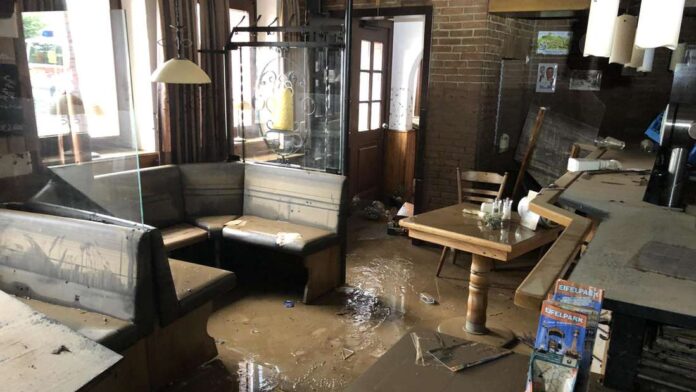

The Rhenish village of Heimerzheim was badly hit by the flood in July 2021. FR editor Martin Benninghoff has revisited the place of his childhood. He tells of home, horror and hope
On the day the water rose there was heaven and earth. How fitting. You have to explain it: Heaven un Ääd, that’s the Rhenish national dish with mashed potatoes and black pudding. In the “Zur Linde” inn in the Rhenish village of Heimerzheim, it’s on the menu for Wednesday, July 14, 2021. The day before the great flood catastrophe in the region, when the heavens opened up and the earth was devastated, just Heaven and Ääd.
The menu paper is slightly yellowed, the showcase to the left of the entrance has splashes of mud. Like a grandfather clock that has stopped in the middle of a bombed-out house, the menu seems to preserve a state that will never return. Heaven and Ääd was supposed to be the last dish in the rustic inn for a long time. The bratwurst with beans and potatoes, planned for the following day, was no longer served. On the late Wednesday evening of July 14th, the tranquil Swistbach, which flows a few meters past the restaurant, grew into a destructive stream after hours of heavy rainfall, which took streets, walls, houses, shops, livelihoods and the “linden tree” with it crack.
The trauma of the flood can still be felt in the village
The village of more than 6,000 people, located in commuter distance to Bonn and Cologne in southern North Rhine-Westphalia, has been a wounded village ever since. A year after the catastrophe, it is still tending to its wounds. It’s unrecognizable. For the people there, it is a time of farewell and many new beginnings. Heimerzheim is also my village. I’ve been away from where I grew up and went to school for more than 22 years. But what is learned is easily reactivated when looking again arises because something has been destroyed that was thought to be set in stone for eternity. My old schoolhouse on Swistufer: It is empty, deserted, the inventory destroyed. But it’s already being renovated. Next door to a farm that used to smell in the middle of the lesson, which is why we always kept the windows closed. The pungent odor hits my nostrils again. The sheep drowned in the July flood. The farmer’s father, he is said to have died of a heart attack at the sight of the dead animals. Everything seems fragile. The outer wall is supported, otherwise there is a risk of collapse.

More memories come to mind: The Nolden shop, where you could literally buy every screw, every nail, every nut individually, and whose owner I was always a bit afraid of as a child: washed away and closed. There will never be a shop like this again. Or the Kurscheidt stationery shop, formerly the commercial center: closed. After the flood, the owner switched to tending the garden and graves. Appropriate for a village that is dying and growing again at the same time. His shop is being renovated, and the Sparkasse branch, which was also flooded, is moving in here. Will their counters and ATMs ever have the same meaning for a child as the comics, Pelikan fountain pens and satchels at Kurscheidt once did?
For people, the catastrophe is not a question of banal childhood memories (nostalgia always makes you a bit blind to the new), but of the present and the future, in short: of survival. Thomas and Andreas Reichelt, the two landlords of the “Linde”, are standing next to the rubbish container in front of their destroyed restaurant. Apart from the menu and the green, curved lettering above the door, little is left that is reminiscent of the old restaurant after the water in the Swist stood almost two meters on the ground floor. For her, the July evening was a personal turning point: “We were at home in the evening,” says Thomas, the older of the brothers. The chef lives above the restaurant. “We didn’t think it would be so catastrophic.” The Reichelts run the 170-year-old family business in the sixth generation, the last “flood of the century” in 1984 did not hit the restaurant.

This is one of the reasons why the brothers were relaxed on the day of the disaster when the water rose. They organized sandbags as a precaution, but they only got nervous when the water rose later in the evening and then quickly crawled up the creek road. Later, the masses of water pressed against the massive walls that withstood. But not the door that was pushed in. The fight against the flood was lost by then, the restaurant could no longer be saved, especially since the electricity went out, the pumps were no longer running and the water then flowed in from the other side. “In the beginning we couldn’t even think about what would become of us,” says Thomas Reichelt. First the shock of fainting, then, as the water drained and the fire department pumped it out, the shock of seeing the true extent of the destruction.
Now, a year later, we are standing together in her garden behind the house, which looks like a shell on the inside. A palm tree grows in the corner, on the leaves of some plants there is a greasy mixture of residues of mud that can hardly be washed off. Behind it, in a garage, cutlery, glasses, tapping utensils, everything that could be saved from the floods are stacked up. In the weeks after the flood, volunteers had cleaned the worst of the dirt from the items, which are worth real money from restaurateurs. It was “a huge mess” before, says Thomas Reichelt. The brothers are grateful for the help, but also disillusioned because everything is taking so much more time than they had hoped. “We thought we’d be ready again by Easter,” says Andreas Reichelt. They don’t know yet if they will be able to open again this year. Everything is moving: craftsmen are working inside, fine cement dust is in the air, the exposed iron girders come from the old village smithy, which closed only a few years ago. The kitchen should be running again, the clubs are coming back. The bowling alley is supposed to go back into the basement. Sometimes nothing changes even when everything changes.

You can walk through this battered place with different glasses. Whoever only wants to see decay sees only decay. Anyone who sees opportunities for a new beginning in all the destruction will find what they are looking for. The only thing that is undisputed is that the village is changing, delivery vans from craft businesses are parked everywhere on this day. The noise of grinding, sawing and hammering booms from the houses, whose windows and doors have been left open for a long time to dry. “It’s a different time,” says Wilfried Rang, who runs two driving schools in Heimerzheim and the nearby town of Rheinbach. And: “You have to break away from the old.” However, that is not easy for everyone, especially not for the elderly, says Rang. Those who no longer have the strength to renew themselves are hit all the harder by the destruction of their familiar surroundings. Many have moved away, some house ruins remain empty. On Swist, across from my old school, is the orphaned birth house of an elderly woman who has lost everything. She moved to her family and left her place of residence. involuntarily.
Heimerzheim is a wounded place for a long time
For others things will continue, even if it wasn’t immediately clear. When the flood came, the family man and driving instructor Rang was busy with the last holiday preparations. After the water had drained away, which had turned large parts of the lower village, including the Catholic church, into a large, brown lake, he asked himself whether that was it for the place, for him, for his business… His answer: no ! The holiday was cancelled, his driving school became one of the contact points for flood workers and volunteers in the weeks and months that followed, and Rang was one of the spokesmen in the Facebook group. He also came up with the idea of getting containers for the businessmen in need so the store could resume business, at least in a reduced form.
Others helped with money, living space, drying equipment, building materials, cooked for the volunteers or helped with the rubble disposal. The solidarity of this large circle of helpers, no matter how understated or exaggerated it may be in hindsight, has long since become part of a new local narrative that could endure. The village, which in my time was always divided somewhat between the long-established residents in the town center and those in the new development areas, the “newcomers”, could acquire a new, more integrative identity away from traditional associations or the churches, which includes everyone who somehow comes from the flood are affected. And that’s actually everyone in town, whether they had water in the basement, in the living room or in the neighborhood.

I’m meeting with Tobias Leuning, a local SPD politician. I knew him as a child, at least by sight. His father was mayor of Heimerzheim for many years and, like my mother, moved from Mülheim an der Ruhr decades ago. The father died last November as a result of illness and was unable to see the comeback of his place. “It’s progressing slowly,” says his son. Slowly probably means: The Volksbank is no longer opening, but the jeweler quickly reopened, as does the restorer next door, Leuning remarks appreciatively, while the gaze wanders to the former interior decorator, whose shop has now opened a senior care service. “Well,” he says without elaborating. That’s how it is with the revitalization of village centers away from the booming suburbs of big cities. The big shops for the even larger walk-in customers rarely come to Heimerzheim.
We stroll through the Frohnhof, named after a farm whose half-timbered main building has been preserved and offers space for a pharmacy. The historical relic is being repaired, the pharmacy business continues next door in a container. The same goes for the flower shop and a cafe. After a year, the Greek snack bar is moving food truck gyros back into its freshly renovated shop, but the bakery, which had enlivened the decades-unused space with its outdoor catering, is no longer opening. The optician sells his glasses in several containers, and on the website the owner thanks him for the many donations: he lost everything on the night of the flood. Where old things are gone, the gap is quickly filled: in the parallel street, the reopened bookshop seems to offer fewer books now, but you can buy rulers and set squares that were previously available from stationers. Where there was another pharmacy before the flood, the stylish hair salon Shiyar has opened. Business life in Heimerzheim now appears more diverse.
The “flood of the century”: The fear of a renewed loss of control is great
Elsewhere, the place has become poorer. For decades, the former “Frings” inn in the town center was the focus of village life. Funerals and weddings were celebrated here. This village culture is long gone anyway, later it was a smoky bar that I would never have set foot in in my life. Later, when this episode was over, other tenants saved the location from vacancy and the town center from the fate of many villages in the region: several Chinese restaurants were followed by a Moroccan restaurant. But the operators first went bankrupt with the flood and then left. Now the rooms are being renovated with the help of state flood aid, says junior owner Thomas Trimborn, whom I meet while chatting on the street. A new tenant has not yet been found.
Not far from there, in one of the containers, Seyit Özer is sitting in front of his sewing machine, working on a shirt. The 68-year-old tailor not only lost his shop, he almost drowned in the brown masses of water. When the town went under, Özer was lying on the sofa in his tailor’s shop, where he wanted to spend the night, as he does from time to time. He was asleep when the water pushed in and only woke when it was literally up to his neck. Özer saved himself on a chair, where he stood for hours until the emergency services brought him to safety. He’s fine today, he says later, smiling in front of the door of his container, cigarette in hand. He was lucky. Like Özer, the people didn’t see the water coming, they weren’t warned. The anger about it is still deep, as deep as the fear that it will happen again.
What will Heimerzheim look like in another year?
This fear is visible: across from Özer’s tailor’s container, there are sandbags in front of an entrance door. A few weeks ago, a video circulated on Facebook that again showed puddles of water after a downpour – in front of the “Linde”. “Panic quickly breaks out,” says Tobias Leuning. It’s the fear of losing control again, some of it based on reality, some as a result of experienced traumatization.
Initially, there was looting in the chaos of the clean-up work, and messages about suspicious incidents were passed on on social media, often with dubious truth. At least that has subsided – and has given way to resentment about allegedly too slow repair work or inadequate crisis management.
Reconstruction is bureaucratic, and that’s difficult to convey to people. Around 1,300 tendering procedures are necessary for the municipal infrastructure of the municipality of Swisttal, to which Heimerzheim belongs, and a great deal of effort had to be expended just to assess the damage. Some things are prioritized, other projects like the restoration of a destroyed pedestrian bridge in a residential area are put on the back burner, to the displeasure of some who do not understand why the small community, the country, the state cannot do more. There is still a long way to go that local politicians like Tobias Leuning have to explain to their neighbors without always being convinced themselves. “We just hope that it will be at least as nice as before,” he says. This is the opportunity for modernization that the old village center needed. Not at the price of a catastrophe, of course. But if it had to happen, you can at least try to make the best of it now. Goodbye, Heimerzheim!