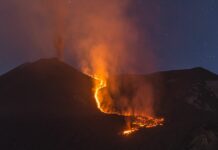
Since last Sunday, September 19, the La Palma volcano continues to “roar” with force. There are nine eruptive mouths that have opened through which lava that reaches 1100 degrees Celsius comes out, but what type of volcano are we facing? It is a strombolian type volcano from which we now explain in detail what it is and how it differs from the other types of volcanoes that exist.
La Palma eruption: What is a Strombolian volcano and what other types of volcanoes exist?
The eruption that has occurred in the Cumbre Vieja volcano on the island of La Palma is the same as those produced in Canrias: of the strombolian type characterized by having explosions that are sporadic and the emission of lava in a discontinuous way.
A type of eruption that can last for weeks or months , so it is something really worrying if we think about the 6,000 neighbors who have had to be evicted from their homes and relocated to sports halls, the homes of friends or family or even the odd hotel. .
A dramatic situation for those families who have already seen how lava washed away and “swallowed” their homes , while those who have been able to keep their home intact still do not know when they will be able to return.
What are the characteristics of a Strombolian volcano?
The volcano of the Strombolian type or with strombolian eruptions gets its name from the Stromboli volcano, located on the wind island of the same name, near Sicily.
This is a type of volcano that has quite moderate eruptions, which mainly consist of the expulsion of fragments of lava and ash, lapilli and bombs, sometimes at a height of a few hundred meters. However, they can alternate with temporary effusive activity (hence lava flows) that lasts from a few days to a few months and then stops. This is precisely what happens with the La Palma volcano.
More rarely, the eruptions are much stronger and it is even possible to witness the emission of pyroclastic flows. The lavas emitted are basalts or basaltic andesites. The combination of explosive and effusive eruptive activities makes stratovolcanoes have a cone.
The explosive eruptions at Stromboli are special because they are rhythmic (every 10 to 20 minutes on average) and because Stromboli activity has continued for at least 2,500 years .
The atypical volcano Stromboli
The mechanism for explaining Stromboli eruptions is generally as follows:
- Magma rising from the depths is rich in dissolved gas.
As a result of the decompression produced by its journey towards the Earth’s surface, gas bubbles form in a similar way to what happens when a bottle of mineral water is opened. - In depth, an area is formed in which magma accumulates – this is the magma chamber.
- The bubbles coalesce into a single large pocket of gas , building up pressure until the magma is violently forced to the surface.
- Therefore, an eruption occurs and it is necessary to wait for a new accumulation of gas in a pocket on the roof of the magma chamber before obtaining a new one.
This mechanism would be, therefore, the one that would explain the rhythmic character of the Stromboli explosions, but in other types of volcanic eruptions more complex mechanisms act, according to volcanologists.
The other types of volcanoes that exist
Apart from the strombolian eruption, there are five other different types:
- Hawaiian : As the name suggests, this type of eruption originates from the islands of “Hawaii” (or Hawaii). It will be characterized by very fluid lava flows. Sometimes small temporary lakes are also created. The lavas of this type of eruption, being very rich in gas, can generate sources of fire that can reach up to 1 km. These eruptions are not very dangerous because there is no risk of explosion, but they can cause significant material damage.
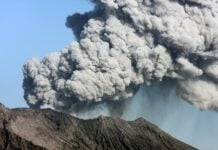
- Vulcaniana : The name of this type of eruption comes from the Italian volcano “Vulcano” which is located on an island located in the north of Sicily. The volumes of smoke expelled by this type of volcano are low but the projected ash can still reach up to 20 km in height.
- Vesuvian : This type of eruption owes its name to Vesuvius whose eruption in -79 AD destroyed the city of Pompeii. This type of eruption is characterized by viscous magma and violent explosions. These explosions can launch projectiles up to 45 km high and thus disperse them over a huge area.
- Peleano : This type of eruption takes its name from the Pelée mountain located on the island of “Martinique”. It is similar to the Vesuvian and Vulcanian eruptions. This type of eruption produces volcanic columns and fiery clouds as huge gas flows, rock fragments and also lava flows that rush down the slopes at high speed.
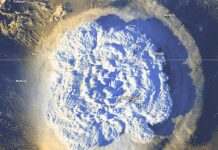
- Hydro-volcanic: This type of eruption is also known as the ” Surtseyana ” type due to the island of Surtsey that suddenly appeared from the sea in 1963 and is located off the coast of Iceland. These eruptions take place underwater and generally at shallow depths. They are caused by the interaction between a large amount of water and the heat of the magma that will raise a cone of rock fragments. If the activity continues and the island eventually emerges, its crater will eventually end above the water and the eruptions that will follow will be less intense.