
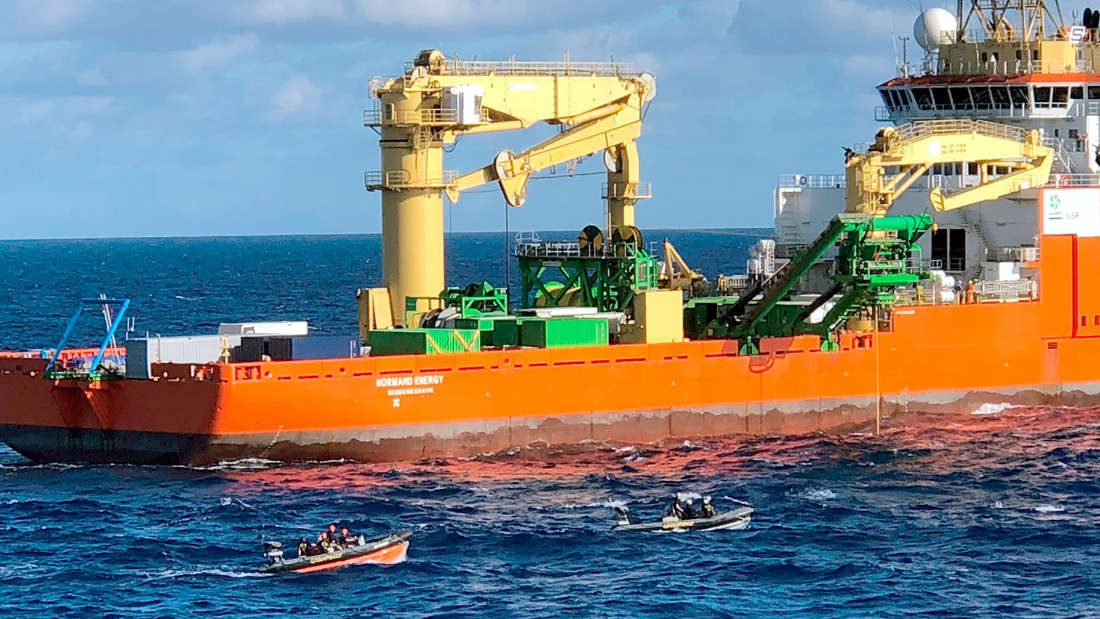
The documentary criticizes the overexploitation of the deep sea and other human crimes against the oceans.
Frankfurt – Humans basically know less about the depths of the sea than they do about the moon. But one thing is certain: a few kilometers below the surface of the water, there are vast quantities of mineral resources; especially those that are indispensable for the construction of batteries. That’s why the industry has made the seabed the next target. A veritable gold-rush atmosphere like that of the Wild West erupted immediately; the claims are already staked. What consequences this has for the fauna and flora that is present despite the gigantic water pressure is completely open; probably not good ones.
After all, the corporations have learned from the mistakes of the past. While above-ground mining was carried out regardless of loss, science is now involved from the start. Michael Stocks was allowed to accompany the researchers on their excursion to the Pacific somewhere in the triangle between California, Hawaii and Mexico. His film Die Greed nach Meer documents their work.
Because this aspect alone was obviously not enough, he makes several detours to the Cape Verde Islands. The connection seems a bit strained, but the tenor is the same, because the archipelago off the west coast of Africa stands for a raid that is usually neglected in the discussion about the protection of nature: Sand is mined here, and in such a way great style, that the saying “the sand by the sea” seems like mockery; What remains are beaches that only consist of boulders.
“The lust for the sea” (Arte): detour to Jacques-Yves Cousteau’s granddaughter
The two levels also differ in tone. While Stocks accompanies the harvest of the deep-sea nodules, which contain manganese, nickel, cobalt and copper, in a comparatively matter-of-fact manner, the African impressions are much more emotional. There is also a clear protagonist here with a local conservationist: A marine biologist founded a small organization dedicated to protecting the beaches and set up an enclosure for sea turtle eggs. The animals also provide the film’s most moving images: they reach sexual maturity twenty years after hatching and return to the beach where they were born to bury their eggs, but that beach no longer exists; the shots of the turtles, presumably confused, crawling over the pebbles are heartbreaking.
| The lust for the sea | |
|---|---|
| directing | Michael Stocks |
| genre | documentary |
| origin | SWR |
| country | Germany |
| Year | 2021 |
From the archipelago, the film makes a detour to the French Atlantic to see Jacques-Yves Cousteau’s granddaughter. A mural of the legendary marine explorer, who once also visited Cape Verde, serves as a transition. Alexandra Cousteau, also an environmental activist and documentary filmmaker, makes no secret of her aversion to deep-sea mining. Stocks, in turn, illustrates the ecological dilemma: the transformation in transport, i.e. the turn to electromobility, will only work with batteries. The industry argues that the necessary raw materials have to come from somewhere; after all, no tropical rainforests would be cleared on the sea floor.
“The greed for the sea” (Arte): What man does borders on suicide
Anyone who hates Stocks could criticize that he uses a lot of Greenpeace footage; a spokeswoman for the environmental protection organization also contributes important statements about human environmental crimes. After all, she presents her warnings without furor: Quite apart from the unforeseeable consequences that the disruption of the habitat in the depths would have, a lot of CO 2 is bound in the deep-sea sediment, which may be released when the nodules are broken down and thus further promote climate change .
What humans are doing to the planet and especially to the seas is, in the long term, bordering on suicide anyway. The oceans are the largest living space on earth and a huge heat buffer, they provide half of our oxygen and a large part of our food, but large parts have long been fished out; Stocks addresses this aspect at the end when an affable Baltic Sea fisherman is allowed to demonstrate what sustainable fishing looks like.
“The Greed for the Sea”
Tuesday, July 26, 2022, Arte,. 8.15 p.m., also available in the media library
“Greed for the Sea” is part of an Arte theme evening
“The greed for the sea – how man exploits the oceans” is part of an Arte theme evening entitled “How much man can the world take?” damming the seas with plastic bottles, followed by a science documentary examining the link between an inexplicably rising incidence of breast cancer and infertility and the chemicals used to make plastic. (Tilman P. Gangloff)


