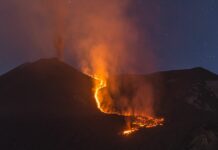
Yesterday, Sunday, the Cumbre Vieja volcano erupted on La Palma . An event that despite its spectacular nature is still dangerous if we take into account that the lava reached hundreds of houses although luckily there was time to evacuate the neighbors . But was it lava or was it magma? What is the difference between magma and lava? Since yesterday we have heard these two words and although very similar, the truth is that there are a series of small nuances that differentiate them.
What is the difference between magma and lava?
Now that we are watching and hearing on television how the La Palma volcano has erupted, we may get confused in the use of the two terms: lava and magma . To avoid repeating the same word twice, they are used as if they were two synonyms, that is, two words written differently but with the same meaning.
However, they are not if we take into account that from a geochemical point of view, magma is distinguished from lava for two very specific reasons, which are the position in which it is found (inside or outside the volcano) and the composition of the one that is done.
What is magma?
Magma is a multiphase fluid at high temperature, this means that it is composed of several phases, in particular a solid phase (phenocrysts) and a liquid phase, which is usually composed of other elements and compounds melted by high temperature and finally by a phase gaseous , which is composed mainly of water vapor and other gases such as CO2 and H2S. Magma tends to reside and remain , sometimes even for long periods, in certain points of the earth’s crust at highly variable depths (between 1.5 km and 10 km), in the so-called magmatic chambers , which are basically reservoirs that feed eruptions. volcanic.
What is lava?
Lava is nothing more than magma that is expelled to the surface by a volcanic system. Lava has above all a lower temperature and it tends to adapt more or less slowly to the environment. Its other characteristic is that during its exit and installation the contained gases are expelled, and the “fluid” mass solidifies, vitrifying, that is, turning glass or becoming microcrystalline or even pumice, depending on the cooling speed that solidifies and incorporates the crystals. that were contained in the magma.
So for the sake of truth, it is not enough to say that magma is inside the earth while lava is on the surface , it should also be specified that magma is molten rock + dissolved gas while lava is molten rock without gases. dissolved (absent because there is no more pressure containment).